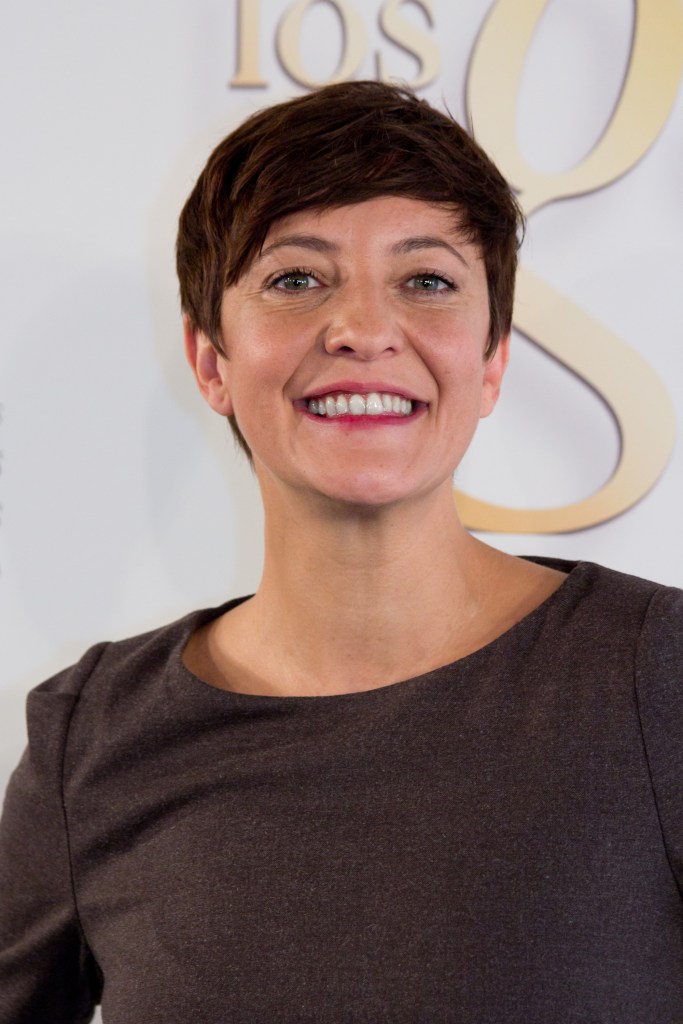


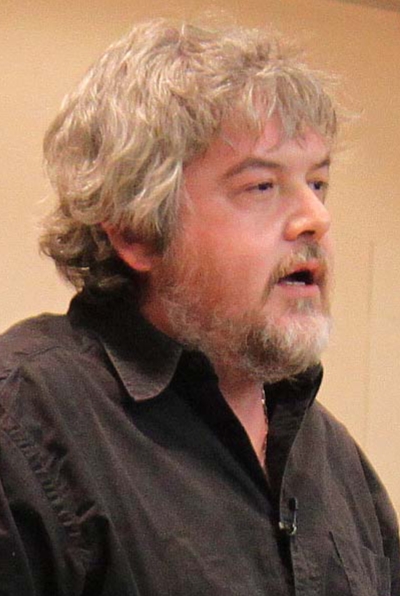


Spanish comedians
left to right:
Eva Hache (photo by Pedro J Pacheco)
Berto Romero (photo by Mutari)
Javier Coronas (photo by Urcomunicacion)
Pepe Colubi (photo by Malopez 21)
Andreu Buenafuente (photo by Pedro J Pacheco)
Ana Morgade (photo by Ruben Ortega)
YouTube has so much free material. There are myriad channels from all over the Spanish speaking world. Of course, all these channels are really adverts aimed at enticing you into a paid subscription. But there’s no need to buy.
Top of my list is Español con Juan. Don’t be tempted to dismiss Juan because of his slightly halting style or his unglamourous appearance. Juan is much more sophisticated than he first appears. His great strength is that he doesn’t deal directly with grammar. For example, he doesn’t plough laboriously through tenses. Instead, he plays out situations which illustrate the correct use of language. He often takes to the streets. This approach makes him successful with the English. Juan is from Granada but has lived and taught in England for over 20 years and he understands very well that English people have NEVER been taught to use their language by learning tenses. He recognises that we are genuinely perplexed, intimidated and inhibited by all talk of rules, even irritated by the use of terms such as pretérito pluscuamperfecto or condicional perfecto. Start with his Tips to learn Spanish (all in Spanish). This series of videos is comprehensive and full of sound advice based on experience. It begins with a warning about Vendedores de humo, in which he cautions against online courses that seem too good to be true: ones that promise you can learn Spanish in 2 months on just 10 minutes of work a day. Beware, he says. If it looks too good to be true the chances are it is too good to be true; all that glitters is not gold.
The other very impressive feature of his work is the candid nature of the stories that he tells about himself. He uses startlingly convincing nightmare scenarios from his past but be careful what you believe because he intersperses his confessions with a cast of imaginary friends and enemies. Often, it is the straight truth. Nevertheless, you remember what he says. Here are two of his memorable performances: the meaning of the phrase meter la pata: https://www.youtube.com/watch?v=x_Qvth0IRfY and how to express probability https://www.youtube.com/watch?v=kTKdxX2rfvE
Juan’s output has been steady over the past 5 years: the creation of a video each week has built an impressive YouTube library which deals with most aspects of learning the language. He puts a lot of effort into his work. He speaks at a pace which is designed for learners and he repeats what he says in different ways throughout each video. He is enthusiastic and enjoys what he does. He has learnt his craft over many years and like all great teachers his lessons are unforgettable and often unorthodox.
Juan also has a list of his favourite YouTube channels for learning Spanish which, once again, you can find in one of the videos in the series, Tips to learn Spanish.
Thousands of miles away is Why not spanish? run by Maria from Colombia and her quietly-spoken US husband Cody from Tennessee (Plus of course their dog, Maya) The speech of both Maria and Cody is naturally unhurried, relaxed and clearly pronounced. They do videos at all levels. Don’t judge them by the early videos that they made back in 2017 when Cody was just learning Spanish. But, if it’s beginners’ lessons you’re looking for these could actually be useful.
Like Juan, they know that using the details of their lives is a way of engaging with their public. In so doing, they show themselves to be unpretentious people who are honest about their lives. The couple recently moved from Tennessee to Bogotá. María often interviews Colombian speakers from other parts of the country or Latin America to demonstrate their varied vocabulary and their distinct accents (not that I can detect many of the local differences). She and Cody also go out onto their neighbourhood streets to make videos about ordinary Colombian life. (It is always a relief to know that if you are off to visit Colombia you are safe in the knowledge that it is a Latin American country where coger means agarrar and not follar.)
At the other end of the glamour spectrum is Superholly who also deserves a mention, if only for her absolutely immense popularity. (At the time of writing she has 4.17 million subscribers). Holly is a gringa who grew up in Mexico and she speaks a flawless Mexican. Iberocentrics tend to look down on Mexican Spanish as it is plagued with anglicisms due to the country’s geographical proximity to the United States and the massive numbers of its citizens who work there. Nevertheless, Holly’s pronunciation is clear as a bell and she uses it to tell long, entertaining stories about her childhood, her brothers and sisters, her mother, her father the linguist, her own career, her motley crowd of neighbours and last but not least, her Mexican husband, Ben. They are a stunningly good-looking couple and their videos are professionally of a very high standard. Their life can look a bit “picture book” and their videos can be somewhat schmaltzy but somehow you forgive them because of the positivity they radiate. However, Holly is not above pouring scorn on the unsuccessful attempts of public figures whose English is not up to the mark. Neither does she miss the opportunity to get her own back on those who have slighted her. She doesn’t name names but I’m sure they know who they are.
And then there is Spanish with Vicente. Vicente once again illustrates his grammatical points by recounting the details of the everyday events of his personal life in small-town Fuengirola. He styles himself as profesor de español online y Director de la Academia de Español Online. I imagine he is both the Director and the only employee of the academy but you have to hand it to him: he is young, clear, personable and much liked. There is a new video each week and he has built up a whole back catalogue that you can always raid to resolve any of your doubts.
My most recent but most spectacular discovery has been Yo hablo, Tu hablas run by Alicia, an extremely clear-headed and clearly spoken teacher. If you do want Spanish grammar explained to you simply and accurately this is the place. I have never heard the difference between ser and estar made as plain as this, nor the various uses of se, nor the use of quedarse as opposed to quedar. Neither will she use terms such as perífrasis without explaining what they are.
A lot of students who want a change from lessons watch the news and current affairs. My humble advice, based upon personal experience, is don’t get too obsessed with the Spanish television or radio news. It might seem a good idea because of its presentation, but the easy-to-understand neutral accent has little to do with the way that people speak; likewise, the ostensible evenhandedness of State broadcasting comes nowhere near the more disinterested standard of the BBC. Newspapers are also written in journalese and their vocabulary is often unnecessarily recherché. Spanish copy editors demand flowery and elaborate writing.
I go instead for the German broadcaster, Deutsche Welle, whose Spanish service specialises in compassionate in-depth documentaries that concern social and political issues, have exceptional speech quality and are based upon excellent research, clean production and superb camerawork. Recently, I watched Después de la huida – Cuando lo ajeno se vuelve un hogar, truly, a beautiful piece of work: https://www.youtube.com/watch?v=Mp54Q85e8nQ
If you want colloquial, you can always try comedy shows of which there is no shortage. Some comedians have a cult following in Spain. Probably the best example is Berto Romero. His most famous show on YouTube is Nadie Sabe Nada, an hour-long improvisation with Andreu Buenafuente. Nadie used to provide moments of great hilarity when an adoring live audience interacted heedlessly with the presenters. However, since lockdown when the audience disappeared halfway through series 7, the programme has definitely gone off the boil.
But, a word of warning. Berto was recently voted the third muckiest comedian in Spain. I don’t know who the first two were supposed to be, but I suspect Pepe Colubi and Javier Coronas might have been the culprits There is definitely a male clique of comedians who dominate Spanish humour and it has to be said that they can be boringly adolescente with their endless scatogical humour and gross sexual exaggeration. However, for whatever reason, there is a big market for it in Spain. (If anybody would like to offer an explanation I’d be very interested). There is a sort of unspoken competition to see how far they can go. They don’t do it because they are unsophisticated. Far from it. Pepe Colubi, who has an unrivalled reputation for obscenity and who appears regularly on Ilustres Ignorantes is otherwise a wonderfully articulate, cosmopolitan and educated person.
Female comedians do more sophisticated, observational humour which doesn’t rely on willy and bum jokes. Eva Hache was a brilliant host of the now defunct TV series, El Club de la Comedia and there is a lot of her best stuff from six or seven years ago. More contemporary is the work of Ana Morgade although she’s taking time off lately as her first baby is due.
Remember, if you are watching anything on YouTube you can always switch on the subtitles which give a rough idea of what is being said. You can also go to settings and reduce the playback speed to hear things a little slower.
Good luck.

 Ingleses