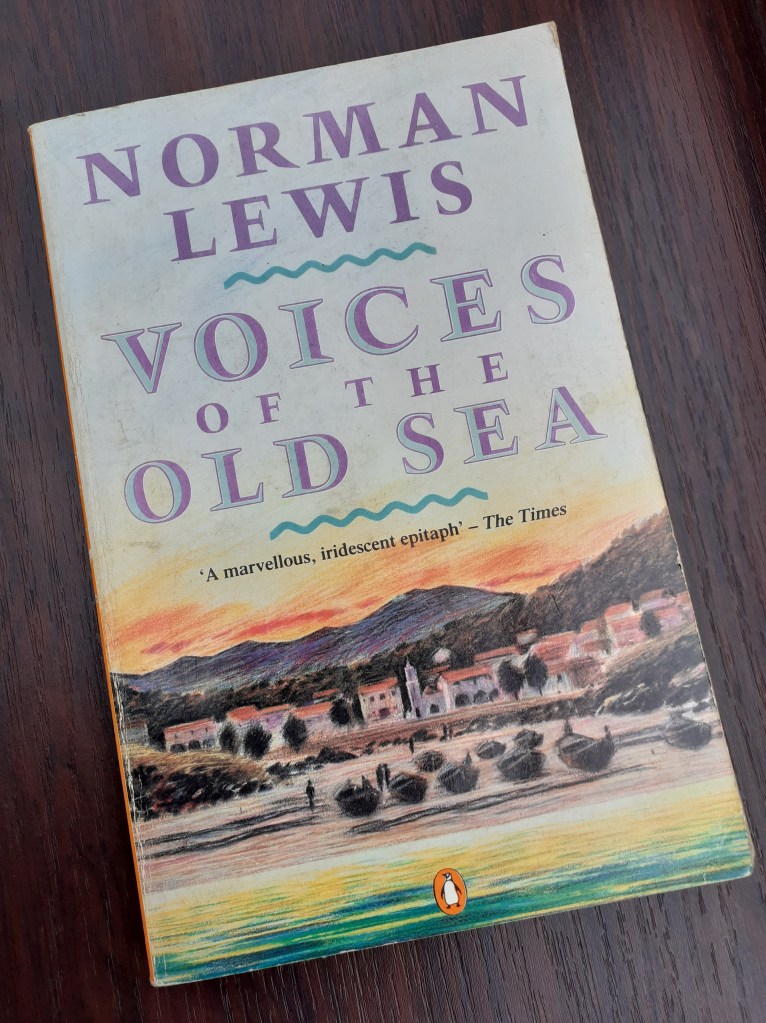
The definitive history of modern Spanish tourism has yet to be written. When somebody does so they have to include excerpts from Voices of the Old Sea by Norman Lewis, an English writer who lived for a couple of years in a remote Catalan fishing village during the late 1940s, at a time before the arrival of mass tourism. Lewis contrasts the innocence of the place with the endemic corruption of local politics. The area is a microcosm of Francoist post Civil War Spain. The provincial politicians and landowners make up the rules, taking advantage of their domination to do whatever takes their fancy. Lewis observes how they invent tourism, appropriating other people’s land, confiscating grounds adjacent to the beach and remodelling the old guest houses to create the primitive hotels that will open their doors to the first English and German visitors. Lewis witnesses the birth of the Catalan tourist industry, the invention of the Costa Brava and the beginning of the inexorable process which will culminate, in only 70 years, in environmental disasters such as that of the poisoning of the Mar Menor. Of course the mass tourist invasion was yet to come, as was the intensification of agriculture and the construction of the blocks of apartments, but they wouldn’t be far behind. By the 1960s the industry would grow like topsy and the die would be cast. The pollution caused by the plague of “affordable” tourism from the countries of Northern Europe and the lack of a local infrastructure that was capable of dealing with the consequences was a lethal combination that could end up killing the Mediterranean, starting with the salt lagoons that border the open sea.
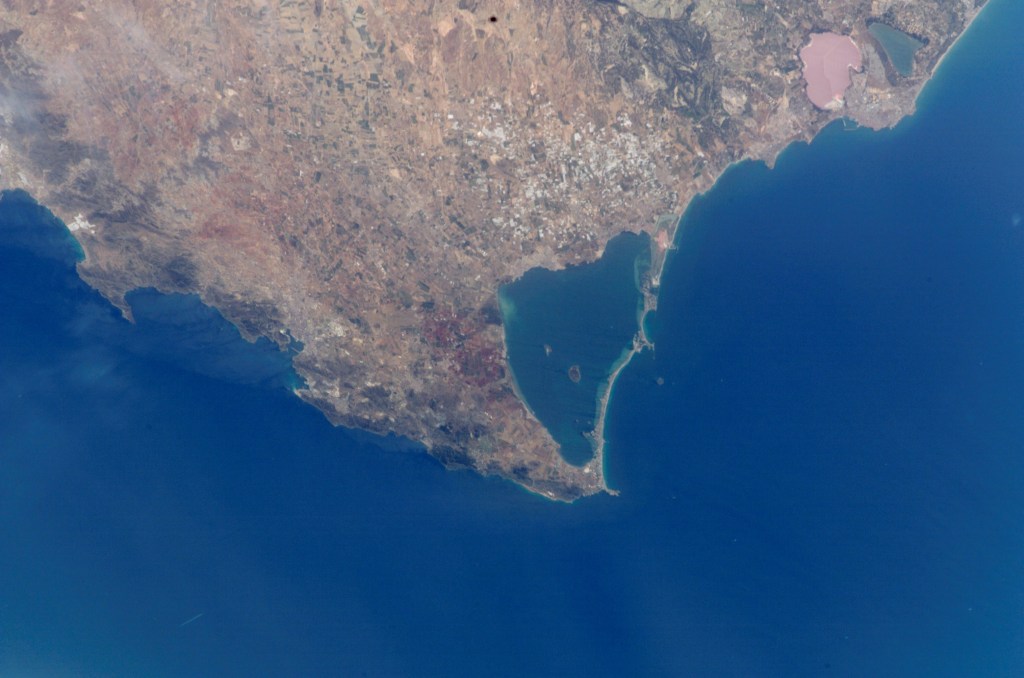
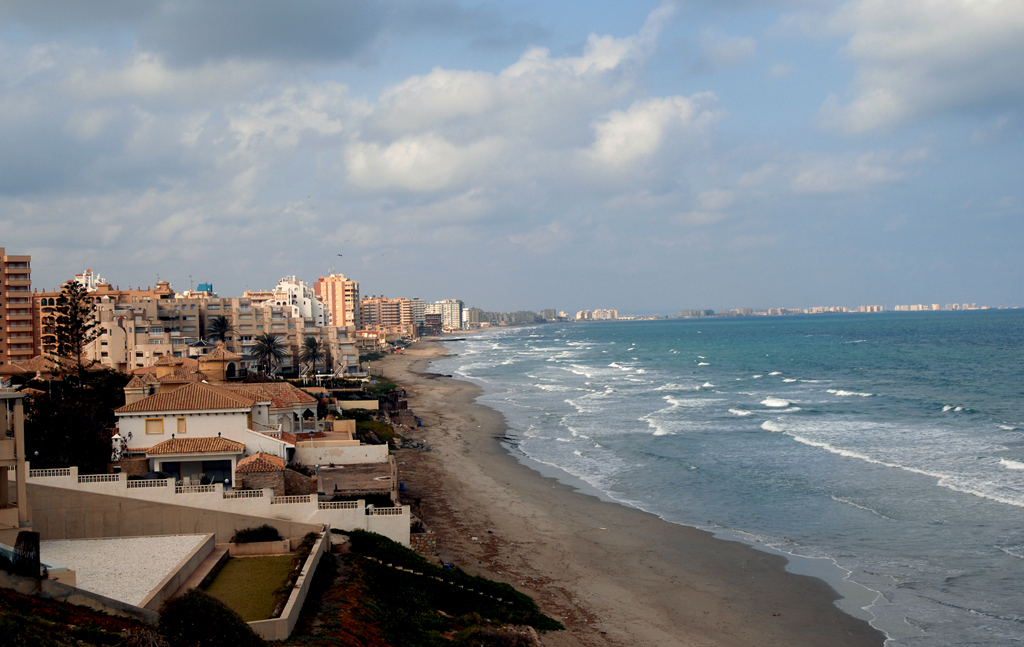
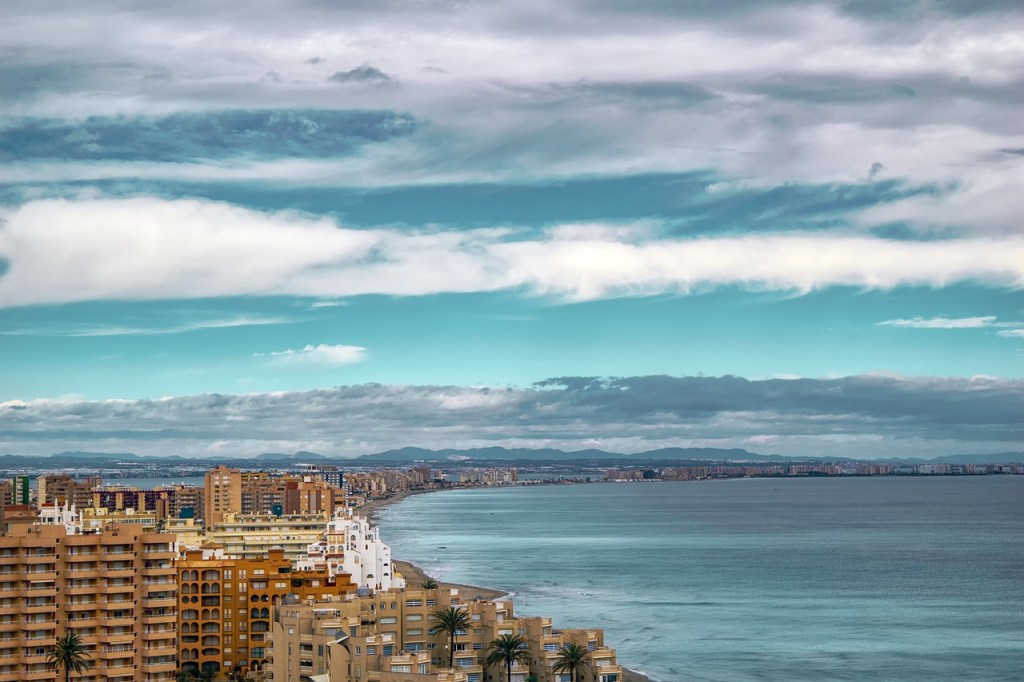
In a guest essay for the New York Times (12.08.21) entitled “The Spanish Coast is Threatened by Death”, David Jimenez writes about the precarious state of health of the Mar Menor. It is a hard-hitting piece which contains links to other excellent articles which explain the catastrophe in detail.
In brief, the ecosystem of the Mar Menor is not capable of dealing with the quantity of fertilisers that ends up in its waters. They arrive at this salt lagoon by two routes. In the first instance they get there in the run-off from the land which surrounds the Mar Menor. Secondly, and more important still, is the devastation caused by the raw brine discharged into the Mar Menor as a consequence of the activity of the many desalination plants that supply drinking water to the local people and the tourist population (The lack of rainfall in the region of Murcia, the insufficient diversion of water into the local River Segura from other parts of Spain and the overexploitation of the aquifers make necessary the generalised use of desalination plants). The raw brine is the infamous “green soup”, the residue that the desalination plants dump into the Mar Menor: a fetid liquid which contains a concentration of nitrates which causes death to all plant and animal life in the sea.
When it’s all said and done the designation of the Mar Menor as a special conservation zone by the European Union hasn’t offered an ounce of protection against everything that has been dumped in its waters. It seems that for twenty years the Government of the Región de Murcia has done little to comply with the European regulations for the protection of the environment in the Mar Menor. Environmental rules are nothing if they are not enforced.
Going back to the matter of the unbridled building boom that began in the 60s, there is an essay on the internet by Sasha D. Pack in which she points out that legislation that could have controlled construction on the Costas did exist during the 60s although nobody could be bothered to enforce it:
“Built hastily and under considerable pressure from land speculators and foreign tour operators, the hotels were with a few exceptions poor imitations of high modernism. The economics of high-volume, low-cost tourism thwarted ambitions of quality in urban design. The rapid sale of coastal agricultural terrains to land speculators drove prices upward, and as a result the objective of maximising tourist volume and density quickly overshadowed pretensions of inventing another Côte d’Azur. The Franco government has often received blame for failing to prevent the “architectural horrors” that beset Spanish coasts. In fact, the regime had adopted urban development laws mandating green space, height restrictions on buildings, and the provision of municipal services. The general disregard for such laws frustrated urban planners and tourism authorities in Madrid throughout the 1960s. As provincial delegations continually reported “clandestine” touristic developments proliferating with no state approval, Francoist officials quarrelled over how better to enforce the law. Along the southern littorals, the resort village that fully met legal urban-planning standards was a rarity by the mid-1960s.”
Tourism, Modernisation, and Difference: A Twentieth-Century Spanish Paradigm Sasha D. Pack University at Buffalo https://www.ucm.es/data/cont/docs/297-2013-07-29-3-07.pdf
Although law-breaking corruption is not a contemporary phenomenon unique to Spain, it would be fair to say that during and after the post-war period the level of fraud in the country has broken all records. I am not saying that it did not exist before. Of course it has existed since the Garden of Eden, but undoubtedly the impunity with which politicians and businessmen who had been good servants of the National Movement acted during the 1960s has contributed to the strong prevalence of dishonesty in civic life that continues to this day.
Lewis published Voices of the Old Sea in 1984. He wrote it based on notes he took while he lived in his unnamed fishing village. In the New York Times of 14/07/85 the book was reviewed by one Barbara Probst Solomon. She accused Norman Lewis of being nothing more than a romantic egocentric who would have preferred the fishing village to remain slumped in poverty rather than to be transformed into a prosperous beach resort. According to her it was “Better a littered landscape than stagnation”.
To me this negative review only indicates that American neoliberalism and Spanish corruption go hand in hand. Neither of them are concerned about the negative consequences of unruly economic growth.
If Norman Lewis is the writer who best captures the spirit of the first moments of tourism at the height of the post Civil War period, there is no doubt that the last novels of Rafael Chirbes best express the general repugnance that people feel for the construction and corruption that has done so much damage to the coast of Valencia. (It must not be forgotten that Voices of the Old Sea is an anthropological study whereas Chirbes’ books are novels, even if the genres do manifest a tendency to overlap.)
Chirbes published Crematorio in 2007 (It was first published in English as Cremation in 2016). The book is a contemporaneous work, set right at the height of the building boom. Ruben, aged 73, is the villain of the piece. He has made his fortune selling “hundreds of prefabricated bungalows erected on plots in dry river beds and ravines that have been falsely recertified during the boom as building land: with their poor foundations it is only possible to live in the bungalows for certain months of the year, and only then because of the relatively mild nature of the local climate”.
Ruben financed his developments by laundering dirty money: cash that came directly from the Colombian drug industry (the cash obtained from the sale of cocaine concealed in the intestines of horses imported legally into the country), roubles que were exported illegally from the former Soviet Union and dollars that flowed from the pernicious activities of the American mafia. Ruben has done whatever was needed to make himself rich. He employs simple immigrants as cheap labour and uses Russian criminals to carry out his more sinister dealings. The book is full of characters who are dying or who die an early death, as well as crooks, hypocrites, criminals, murderers, invalids and addicts.
Very often the prose is foul, gross and distorted as are the lives of the protagonists. As is the case with Chirbes’ next book, On the Edge (first published as En la orilla in Spanish 2013), which deals with the economic depression which follows the boom, Crematorio is a dense volume, difficult to read. The author deliberately ignores the rules of punctuation. Both books are four hundred and twenty pages without paragraphs or commas. They deal with difficult subjects. The laws of society are broken and the author has abandoned the rules of writing.
In Chirbes’ writing, building work sweeps all before it. Orange orchards are ripped from the ground, centuries-old cypresses and pines are sawn off at the base, moscatel vines are grubbed up, market gardens are concreted over, and the wells from which cold refreshing water once came are capped and sealed. Likewise the Arab and Roman remains (the water channels, the ancient walls, the stone built reservoirs etc) are buried beneath the new estates. Chirbes doesn’t deal directly with the protection of the sea but he does mention the developers’ indifference towards the wetlands along the coast: the marshes serve as rubbish tips; they are even useful as places to dump the corpses of those unfortunates who have disrupted the activities of the local mafiosos. In the first chapter of On the Edge, two wild dogs fight over the remains of a human hand that has surfaced from a saltmarsh.
The Fight to Save The Mar Menor
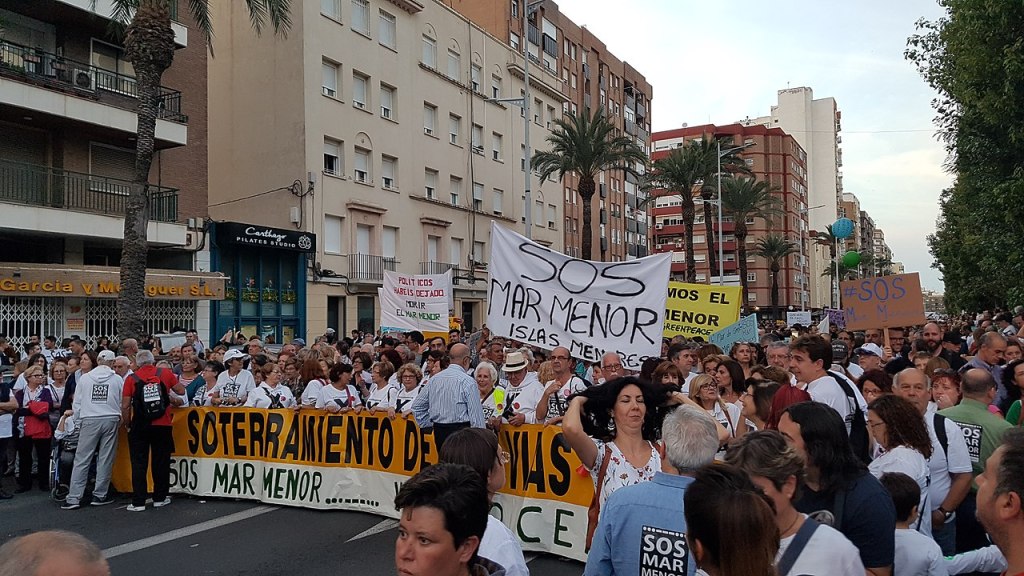
So far, politicians have done nothing to prohibit the flow of chemical substances into the lagoon. They seem content to argue amongst themselves. Once more, the local people have been the ones to take the initiative. An alliance of local people, ecologists and lawyers are calling for the Mar Menor to be given legal status in its own right. It is an extraordinary strategy that has as its aim, the right of the lagoon to exist and to defend itself just like any other person or enterprise. This right will mean, from the moment it is granted, that all the constituent parts of the Mar Menor, the water, all the organisms that live within it and the surrounding soil, must be left in peace and whatever damage that the lagoon incurs, must be made good. The first step for this to happen is to obtain the signatures of 500,000 Spanish voters before the coming 28 October. If the petition reaches this figure it can be placed before the Spanish parliament for debate. Even then, this only guarantees that a debate will take place in the Congress. If the signatures achieve their goal and if the Congress gives a go-ahead to the proposal, the rights of the salt lagoon can be defended in the courts. At the time of writing, some 300,000 signatures have already been collected and the organisers are confident that they can obtain the quantity demanded by law within the given period.
The mass tourism, the never-ending construction, the desalination of the sea water, the discharge of the poisoned brine and the intensification of agricultural production are all connected. It is not possible to deal with any of these huge problems without facing up to them all.
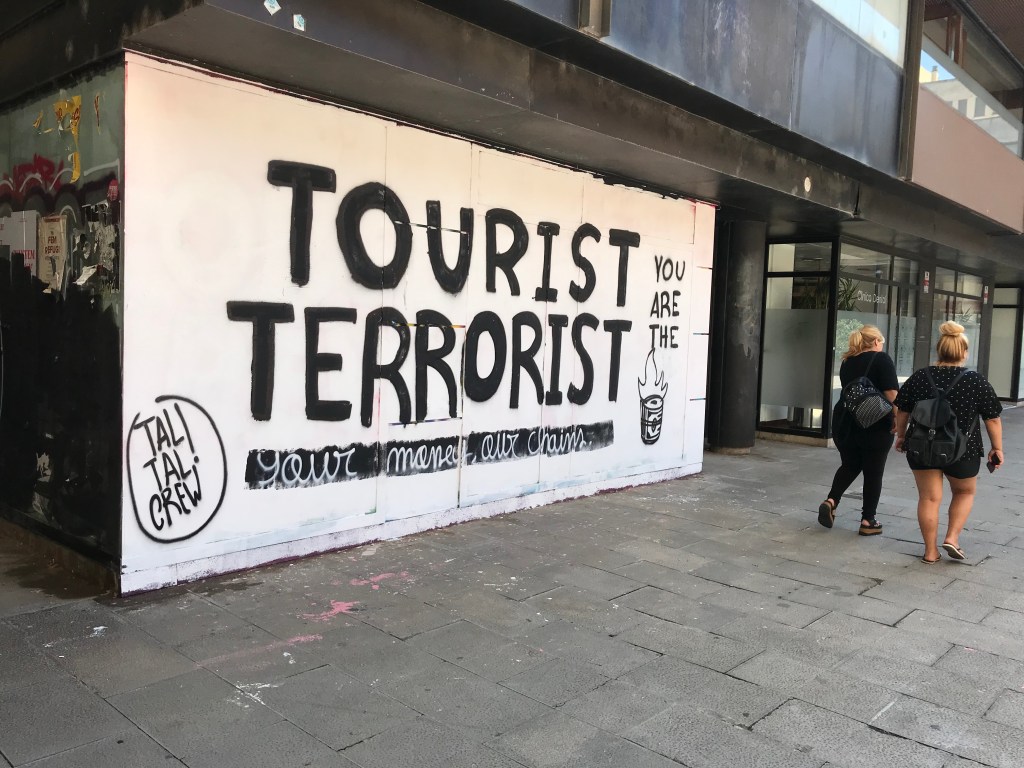
In many places, “tourist” has become a swear word and there is growing public discontent.
However, tourism is going to continue in one form or another, but at this time the government should announce a moratorium on building because the ecosystems can no longer cope with the stress of the agglomeration of so many people on the Costas. Many local people believe that the government should go even further and do the unthinkable: begin a process of compulsory purchase of inappropriate coastal buildings, proceed directly to their demolition and commence a programme of rewilding in these areas, whatever it costs.

 Ingleses