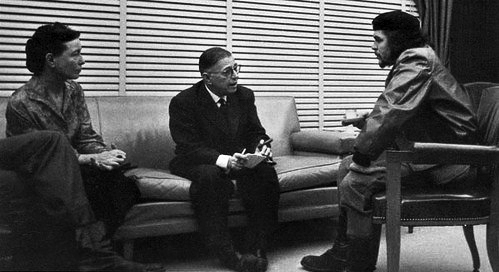
Existentialism reached its modern peak in the arts faculties of western universities during the 60s and 70s, although nowadays it seems that the fervour of its devotees at the time had as much to do with the romanticism surrounding the lives of Simone de Beauvoir, Jean-Paul Sartre and Albert Camus as it had to do with the philosophy’s central doctrinal tenets such as, «existence precedes essence».
During this period existentialism came adulterated with any old arbitrary (but snappy) phrase that justified the student self-indulgence (obligatory) of the time, such as «The road of excess leads to the palace of wisdom», a famous phrase culled from the poems of William Blake.
These phrases were not only celebrated on the walls. They were pronounced out loud, playing to the gallery. So it was that students displayed their existential heart on their sleeve, reflecting the spirit of the times.
However, those times were both the high spot, as well as the beginning of the slow agony of existentialism, a death by constant dilution. This branch of philosophy was so easy-going that it got on comfortably with any other system of human reasoning; it was an amiable and relaxed discipline that combined happily with all other schools of thought from Marxism to sociology to social work. It was a generous bedfellow who didn’t mind if its own point of view didn’t prevail and didn’t get heavy when it was asked to lend its name to another’s cause. More than anything else, it liked to fit in with the wishes of others.
I recently stumbled across Existential Psychotherapy, an American textbook in which the author offered a definition of his method: «Existential psychotherapy is a dynamic approach to therapy which focuses on concerns that are rooted in the individual’s existence». This meaningless sentence illustrates perfectly the way in which existentialism, by the end of the 70s, was beginning to lose its own separate identity. (The only thing more tautological and vacuous is the phrase in the review of the book found in Wikipedia: «Existential psychiatry is a book about existential psychiatry….»
Traditionally, one of the obsessions of existentialism is the problem of the meaninglessness of existence. How ironic it is that existentialism itself should have ended up having no detectable substance of its own, only visible outlined against the figures of its companions.
On top of all this, over the past 15 years the terms existential and existentialist have escaped from the university lecture room and have become part of common parlance. This linguistic emigration seems to have originated in the media. The two words are used as adjectives and are used in conjunction with nouns in order to imply that there is an imminent danger of the elimination of something, even a harbinger of death. Here is, for example, is a headline in 2019 in the Telegraph, a British newspaper: «The Conservatives may not survive the most lethal existentialist crisis in their history”.
For some old fools like me, the 60’s were an idyllic era and it pains me to think of the degradation of existentialism even though I know that my own feelings are nothing but more meaninglessness. In this universe the only thing that remains constant is change. Everything is recycled, including us.

 Ingleses