by Felipe Fernández-Armesto

Until the publication of this book, Magellan’s reputation has remained largely uncriticised. What Felipe Fernández-Armesto has done to amuse himself during lockdown has been to carry out an exhaustive reading of all the sources on Magellan’s famous «circumnavigation» of the globe. As a result, the author has concluded that the time is ripe to confront the undeserved apotheosis of this paranoid murderer.
This is a magnificent book that completely dismantles the whole scaffolding of lies that, over five centuries, has been erected around the figure of Ferdinand Magellan in order to fabricate and maintain an image of a good, scientific and courageous man who circumnavigated the world without falling into the trap, as many did, of making enemies of the indigenous peoples they encountered during the time of the «discoveries». In the post-imperial world in which many of us like to believe we live, all other Christian crusaders have already been unmasked and their cruelty exposed for all to see.
Many of the statues of these men (for they were always men) have been torn down and the stories of their achievements have been rewritten to correct the old image of them as benefactors of the human race. A small local example recently took place in my own city of Bristol: an angry mob pulled down the statue of the 17th century slaver, Edward Colston, and threw it into the dock.
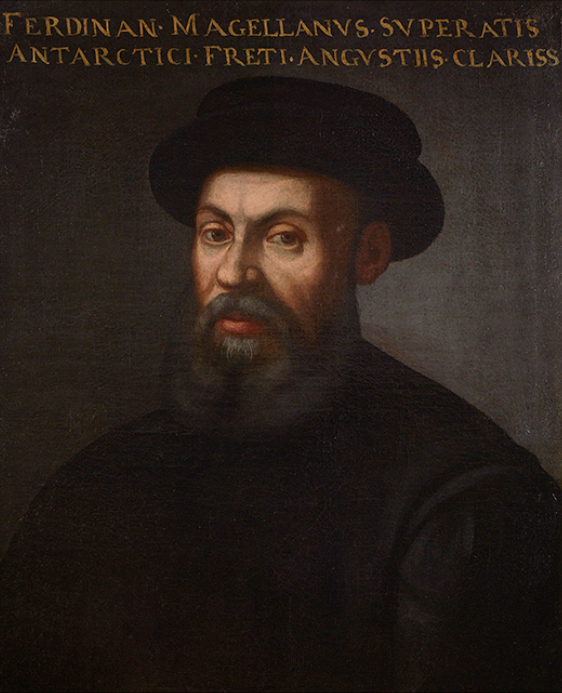
An anonymous portrait of Hernando de Magallanes del siglo XVI o XVII (The Mariner’s Museum Collection, Newport News, VA) Public domain. Via Wikimedia Commons:
Magellan was a paranoid, stubborn and brutal Portuguese adventurer who parted bad-temperedly from King Manuel of Portugal when the latter flatly rejected the idea of funding the search for a strait through which one could pass through South America, cross the Pacific Ocean and reach the Moluccas, the so-called «Spice Islands», from the west. Frustrated and morose, Magellan renounced his allegiance to the Portuguese crown and offered his services to the Casa de Contratación in Seville. After much consideration, he was offered a fleet of five caravels and a generous budget. However, neither King Charles of Spain nor Bishop Fonseca of Burgos, the main bureaucrat of the Casa, trusted this impetuous, selfish and disobedient man and had serious doubts about his intentions. To keep an eye on the renegade Portuguese, the two insisted that their own confidants should accompany him. They also installed a system of checks and balances on board that limited Magellan’s power. Power would be shared amongst several officers who would exercise undisputed control over key responsibilities. For example, Juan de Cartagena was given full responsibility for governing the expedition’s finances, giving him absolute control over what Magellan could buy and bring on board. They included their own pilots in the crew and insisted that two loyal Spaniards, Luis de Mendoza and Gaspar Quesada, should captain two of the other five ships. Thus, by taking authority away from Magellan, a difficult and aggressive man, the preconditions for conflict on the high seas were created.
From the moment he set sail, Magellan did all he could to foment a mutiny that would justify the degree of repression that a few months later would rid him of these officers who had been sent to meddle in affairs that he considered to be his alone. Before he stumbled upon the strait that would eventually lead him to the Pacific Ocean, that is, still on the coast of Patagonia, Magellan had already precipitated the insurrection and the subsequent settling of scores had already taken place. In a single incident he disposed of all untrusted crew members, stabbing, hanging and abandoning them where they had no chance of survival. Most of his victims were Spanish officers, the trusted men of the King and Bishop Fonseca. Luis de Mendoza and Gaspar Quesada were killed and Juan de Cartagena and a priest, Pedro Sanchez de Reina, found themselves abandoned to their fate on the inhospitable coast of Patagonia.
He not only ruthlessly executed members of the crew of his own ships but also killed any natives who annoyed him. Upon reaching the Mariana Islands, the inhabitants made off with some of Magellan’s supplies as well as the skiff the ship was towing. Magellan responded like any good conquistador: he sent a death squad to the robbers’ island to murder dozens of natives with crossbows and burn their village of some fifty huts.
From there he set sail for the Philippines without delay, contrary to his promise to the king to go directly to the Spice Islands. It seems that it had always been his intention to get rich quick from the gold of the Philippines and to appropriate one of the islands for his own exclusive domain. When he arrived in the archipelago he began to behave as he had done in the Marianas. He treated the native people with contempt and belligerence, burning whole villages to intimidate them.
However, Magellan made the lethal mistake of agreeing a mutual defence pact with one of the lesser kings of the island of Cebu and died in a poorly planned and very unequal battle.
In other words, he did not even have the honour of being the first person to circumnavigate the world, although many continue to credit him with this feat. Magellan fell short because of his stubbornness, his violence and his eagerness to profit from the gold of the Philippines.
There is an interview with Felipe Fernández-Armesto about this book on the YouTube channel, Travels Through Time which you find through the following link:
 Ingleses