If you’re visiting London, why not drop in on Dr Johnson

If you are planning a visit to London why not drop in at the house of the celebrated 18th century author and lexicographer, Samuel Johnson, the man who most famously said, “When a man is tired of London he is tired of life”.
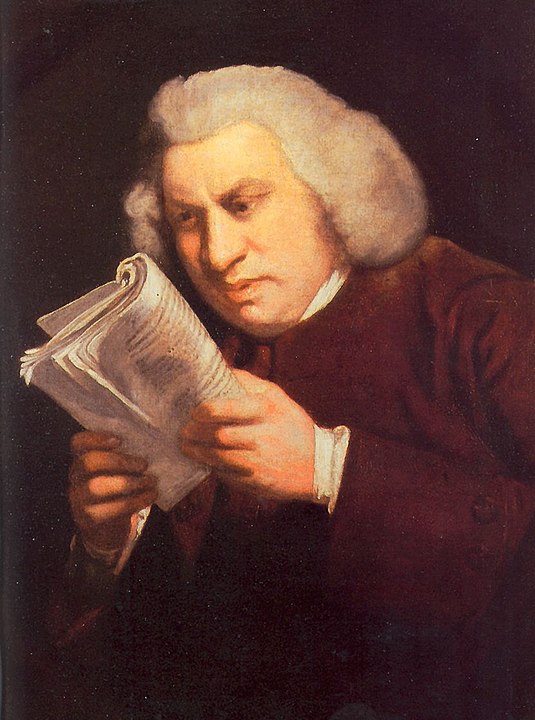
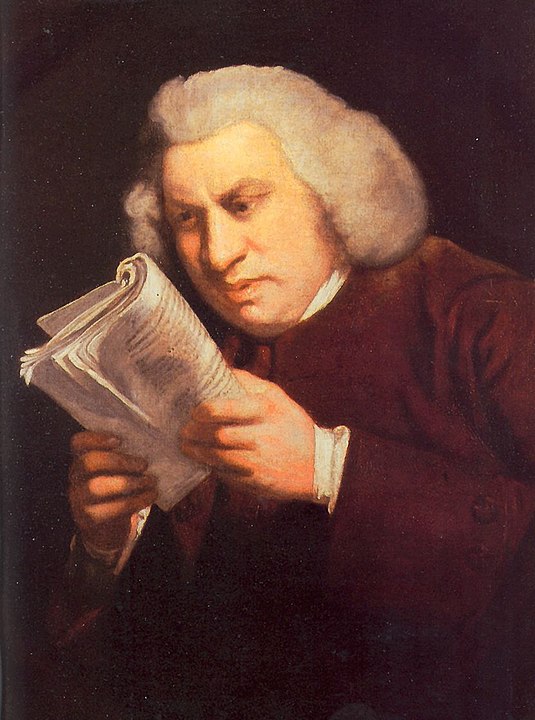
Samuel Johnson by Joshua Reynolds 1775. Wikimedia Commons

Johnson was a tall and imposing figure with a strong and robust constitution. He had two outstanding mental characteristics. He suffered from Tourette’s Syndrome and had a phenomenal talent for summarising and defining: a man who hit the mark with his generalisations, coined phrases that are still in use in modern English and who invented epithets that have echoed down the centuries.

Johnson was born in 1709 in Lichfield in the English Midlands, he studied at Oxford University and lived the greater part of his life in London, where, at the age of 39 he was commissioned by a group of publishers to write a dictionary of the English language. Until this time the spelling of the language had been somewhat chaotic and idiosyncratic, everyone employing their preferred letters in the order that they felt fit. Sometimes the arbitrary orthography led readers to misinterpret what they were reading, so much so that sometimes they lost the sense of the words or misconstrued the intentions of the author.

Johnson insisted that he wouldn’t need more than 3 years to complete the dictionary. He would also do it on his own. When somebody mentioned to him that the Académie française had employed 40 academics for 40 years in order to compile their dictionnaire, Johnson replied in his typical sarcastic and biting fashion: «This is the proportion. Let me see; forty times forty is sixteen hundred. As three to sixteen hundred, so is the proportion of an Englishman to a Frenchman.»

At that time the English and French could not abide one another. Johnson was no exception to the rule. Ever since the Twelfth Century the two countries had been almost permanently at war. Even today there is still the odd historian or commentator who will refer to the French as «The Old Enemy». (It has to be said that Johnson did not reserve all his bile for the French: he roundly and categorically condemned any person whom he considered to be a foe.)

Johnson’s single-handed A Dictionary of the English Language was published in 1755, and until the first arrival of the Oxford English Dictionary in 1928, his work was the bible of British orthography.

Samuel Johnson and his equally famous biographer, James Boswell, met in 1763. Johnson was 32 years older than Boswell, a young Scottish aristocrat who was working as a lawyer in London. Despite their difference in age the two men forged a strong and lasting friendship. Boswell admired Johnson with an almost reverential attitude. Some commentators say that, for Boswell, Johnson was a father figure, an older man, kinder and more affectionate than his own father.
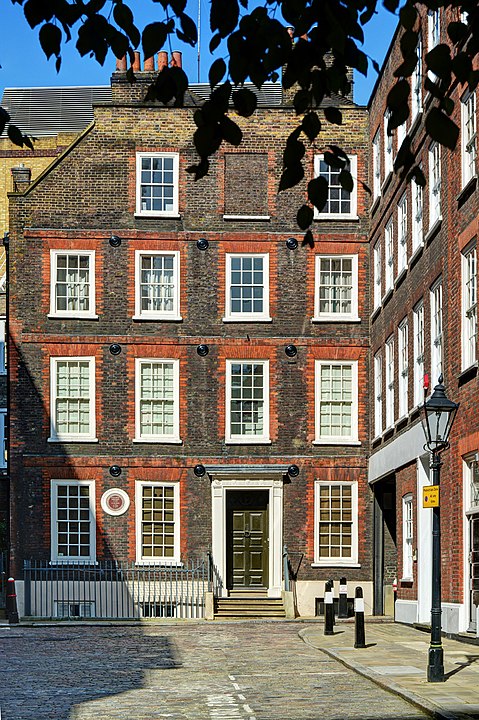
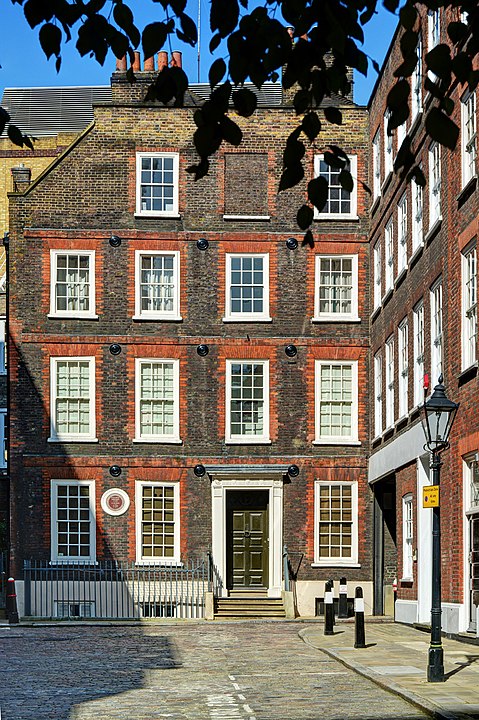
Johnson’s house in Gough Square, London. Photo by George Rex

When they met, Johnson was living in Gough Square in the City of London, in a house that had been built towards the end of the seventeenth century. The house is open to visitors and is very interesting, especially the top floor where Johnson worked on the dictionary. Here you can leaf through a facsimile edition. It’s worth a look inside the dictionary as Johnson could not resist including his opinions and humorous remarks amongst the entries. The oft quoted example is that of the definition of Oats: «A grain, which in England is generally givento horses, but in Scotland supports the people.» You can borrow written guides in various languages to the exhibits in the house. Entry: Adults £8, concessions £7, children £4. https://www.drjohnsonshouse.org/

Nearby is Ye Olde Cheshire Cheese, a pub in which Johnson used to eat and drink. The local is more or less as it was when it was rebuilt after the Great Fire of London (1666). A notice indicates where Johnson habitually used to sit. You don’t have to pay to go in but perhaps you ought to buy a pint or have a glass of something. The food’s quite good.

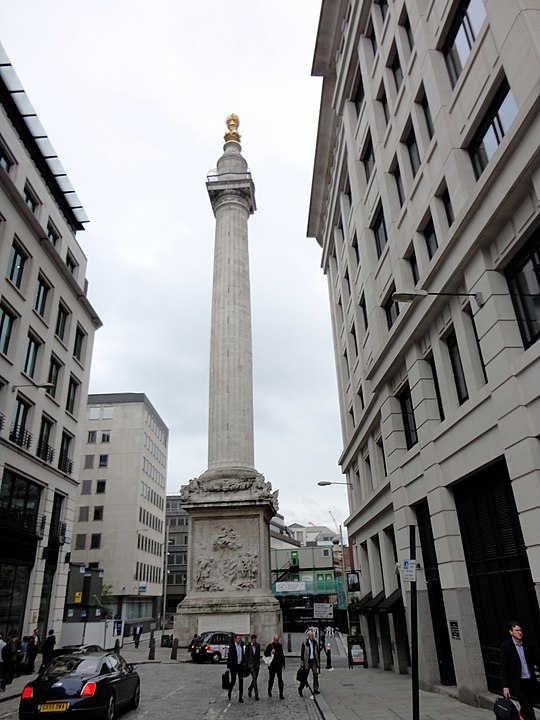
A few years after the Great Fire, the architect of the reconstruction of the City, Sir Christopher Wren, had a monument built to the devastation, a column erected at the point where the fire had begun near Pudding Lane. The view from the top, 60 metres above the ground, afforded intrepid citizens impressive views over the rebuilt city. The tower is a mile west of Johnson’s house. Today it is dwarfed by the skyscrapers which surround it although in its time it was a giant on the horizon: it has 311 steps. You’d be ill advised to try to do it without a rest on the way up.
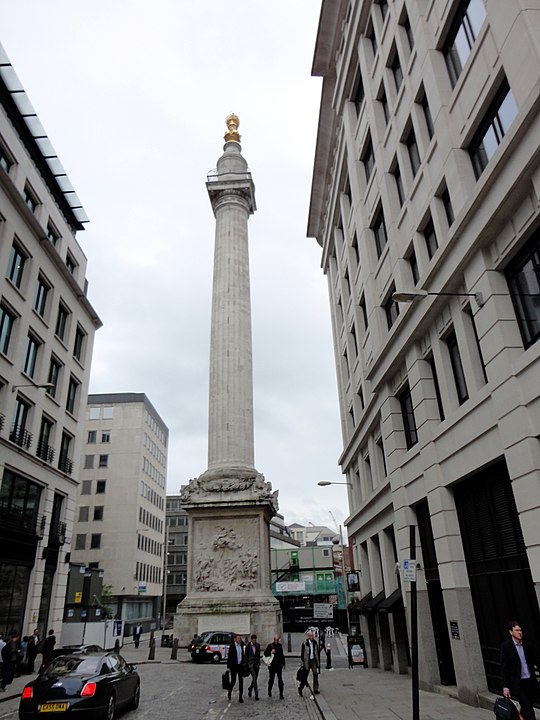
The Monument to the Great Fire of London. Photo by Fastily

In the 18th century, when most people were quite unaccustomed to heights, the ascent could prove terrifying. One of the people in whom the climb did instil fear was James Boswell. In 1763, the year in which he met Johnson, Boswell decided he should pay a visit to the Monument. Half way up he had a panic attack but he screwed up his courage and carried on to the top as he did not wish to lose face. He described how he felt as he emerged at the top: «…it was horrid to be so monstrous a way up in the air, so far above London and all its spires». If you wish to do the climb you will have to pay: adults £5.80, children £2.90. You can’t buy or reserve tickets on line. You have to queue. But it’s worth it. https://www.themonument.info/
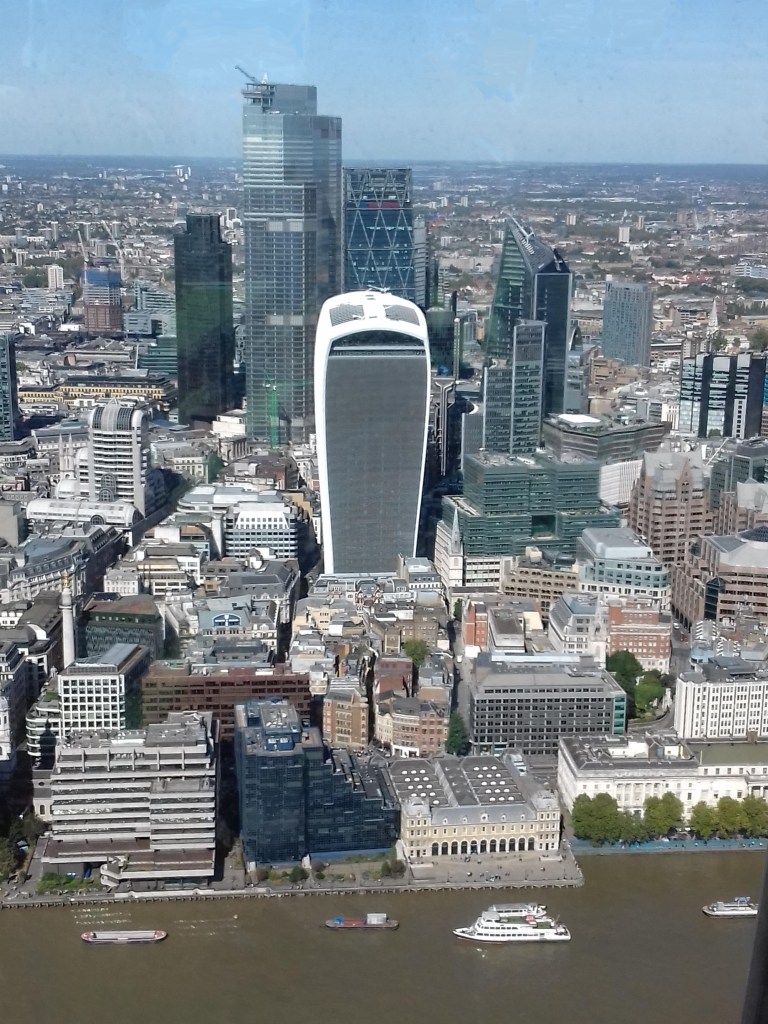
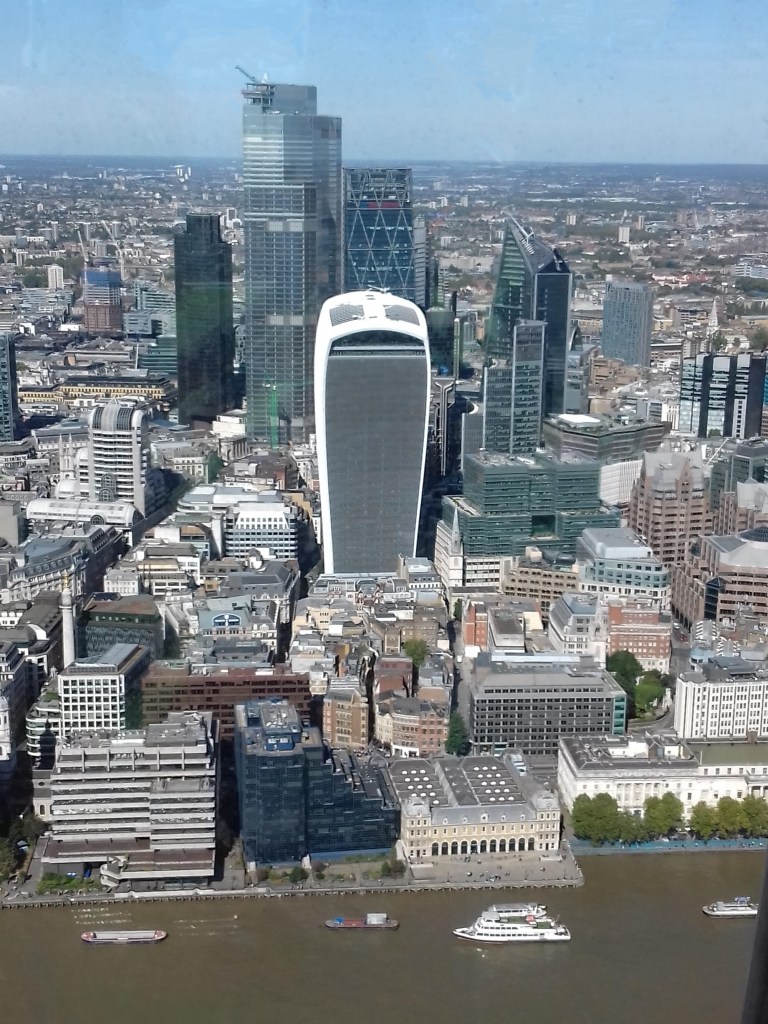
20 Fenchurch Street, the Walkie-Talkie. You can spot The Monument in the bottom left corner of his photo by Gab.pr

These days the Monument seems tiny in front of the skyscraper, 20 Fenchurch Street, the so-called Walkie-Talkie. Unlike the Monument you can visit this building for free. You only have to reserve on line. Not only do you get a marvellous view of the River Thames and the centre of London from the observation platform, but you can also visit the exotic sky-garden situated on the uppermost three floors of the building. Also up here are bars, restaurants and live music from time to time. https://skygarden.london/

If you fancy the idea of visiting the remaining churches that Wren rebuilt in the decades following the Great Fire, you can choose from the various guided walks offered online. For example, the City Guides website https://www.cityoflondonguides.com/tours offers one of these walks every Tuesday at 11am. It costs £12 and £10 concessions. All these churches would have been brand new buildings in Samuel Johnson’s time and would have been very familiar to him. Those that remain are real gems of seventeenth century London. This walk is highly recommended. City guides offer several other guided walks that explore the neighbourhood in which Johnson lived and worked.

Johnson died in 1784 and you can visit his grave in Westminster Abbey where he is entombed alongside all the other greats of English literature in Poets’ Corner. But, watch out, the admission prices are phenomenal: adults £25, concessions £22, children 6-17 £11, under 6s free. https://www.westminster-abbey.org/
¿Estas planeando una visita a Londres? Vale la pena que pases por la casa de Samuel Johnson

Si estás planeando una visita a Londres vale la pena que pases por la casa de Dr Samuel Johnson, el célebre lexicógrafo y autor del siglo dieciocho, el hombre que aseveró famosamente, «Cuando un hombre se aburre de Londres se aburre de la vida».  (“When a man is tired of London he is tired of life”)

Samuel Johnson por Joshua Reynolds 1775. Wikimedia Commons

Johnson era un hombre alto e imponente con una complexión fuerte y robusta. Tenía dos características mentales sobresalientes. Padecía el síndrome de Tourette y poseía un talento fenomenal para resumir y definir: un hombre que acertaba en sus generalizaciones, acuñaba frases que todavía se oyen en el inglés moderno, e inventaba epítetos que siguen repercutiendo por los siglos. 

Johnson nació en 1709  en Lichfield en el centro de Inglaterra, cursó estudios universitarios en Oxford y vivió la mayoría de su vida en Londres donde, a la edad de 39 años, un grupo de editores le contrataron a escribir un diccionario de la lengua inglesa. Hasta entonces la ortografía del idioma había sido algo caótica e idiosincrásica, la gente deletreando como le daba la gana. Incluso, a veces, la confusión ocasionada por la ortografía aleatoria llevaba al lector a malinterpretar lo que leía: tanto el sentido de las palabras como las intenciones del autor. 

Johnson insistió que él no necesitaría más de 3 años para dar por finalizado el diccionario. También él lo haría por sí solo.  Cuando alguien le mencionó que la Académie française había empleado a 40 académicos a lo largo de 40 años para recopilar la nueva edición de su dictionnaire, Johnson respondió de su típica manera sarcástica y mordaz:  “He aquí la proporción: a ver, 40 por 40 son 1.600. Así es la proporción de un inglés a un francés: 3 valen 1.600”. 

En aquel entonces los ingleses y los franceses no se podían soportar. Johnson no era ninguna excepción a la regla. Desde el siglo doce había existido entre los dos países un estado de guerra casi permanente. Todavía queda algún que otro historiador o comentarista que sigue refiriendo a los franceses como “el viejo enemigo”. (Hay que añadir que Johnson no sólo despreciaba a los franceses: tenía juicios condenatorios, contundentes y categóricos para toda persona que le contrariaba.)

El diccionario se publicó en 1755 y hasta la publicación de la primera edición de la Oxford English Dictionary en 1928 la obra de Johnson, que el casi hace por su propia cuenta sin la ayuda de nadie fuera de unas escribas, fue la biblia de la ortografía inglesa durante 173 años.

Samuel Johnson y su igualmente famoso biógrafo James Boswell se conocieron en 1773. Johnson llevaba 32 años a Boswell, un joven escocés de ascendencia aristocrática que trabajaba de abogado en Londres. Pero, a pesar de la diferencia en años, los dos hombres forjaron una amistad firme y duradera. Boswell admiraba a Johnson con una actitud casi reverencial. Algunos comentaristas dicen que, para Boswell, Johnson era una figura paterna, un hombre mayor más simpático y cariñoso que su propio padre. 

La casa de Dr Johnson en Gough Square, Londres. Foto por George Rex

Cuando se conocieron, Samuel Johnson vivía en Gough Square en una casa de la Ciudad de Londres construida en las últimas décadas del siglo diecisiete. La casa se puede visitar y es muy interesante, especialmente el último piso donde Johnson trabajaba sobre el diccionario. Aquí puedes hojear una edición facsímil. Vale la pena echar un vistazo dentro del libro porque Johnson no podía resistir la tentación de incluir sus propias opiniones y observaciones humorísticas sobre las definiciones. El ejemplo que se suele dar es de la definición de la avena: “un grano que se da generalmente a los caballos en Inglaterra, pero en Escocia alimenta a la gente”. El museo dispone de folletos informativos sobre la exhibición en varios idiomas, el español incluido.  Entradas: Adultos £8, concesiones £7, niños 5 -17 años £4. https://www.drjohnsonshouse.org/

Cerca de su casa está Ye Olde Cheshire Cheese, El viejo queso de Cheshire, un pub en que Johnson comía y bebía. El local se conserva más o menos igual a lo que era en el siglo dieciocho. Está señalado el sitio en el que Johnson solía sentarse. No tienes que pagar una entrada pero sería considerado maleducado que no pidieras nada de beber ni comer.

Unos años después del Gran Incendio de Londres (1666) el arquitecto de la reconstrucción de la ciudad, Sir Christopher Wren, mandó construir un monumento a la devastación, una columna erigida donde se había iniciado el incendio, una torre de más de 60 metros de altura desde la cual se daban unas vistas muy impresionantes de la ciudad renovada. La torre se encuentra a una milla al oeste de la casa de Johnson.  Hoy en día el monumento queda empequeñecido por los rascacielos que lo rodean aunque para su época la torre era un gigante: tiene 311 escalones y no se puede subir de una sola tirada. Hay que parar y descansar varias veces. Aún así, la subida puede dejarte hecho polvo.

El monumento al Gran Incendio de Londres. Foto por Fastily

En el pasado, cuando la gente estaba menos acostumbrada a tales altitudes y tenía más miedo a las alturas el ascenso podía resultar aterrador. Una de aquellas personas a quién sí le metió miedo fue el propio James Boswell.  En 1763, el año en que él y Johnson se conocieron, Boswell  decidió visitar el monumento. A medio ascenso sufrió un ataque de nervios. Pero, sacó fuerzas de flaqueza y perseveró para llegar a la cima porque no quería perder la dignidad. En la cima dijo que “fue horrible estar a una altura tan monstruosa, en un sitio tan elevado, encima de Londres y todas sus agujas: «…it was horrid to be so monstrous a way up in the air, so far above London and all its spires«. Si quieres visitar el monumento tienes que pagar: adultos £5.80 y menores £2.90. No puedes comprar ni reservar entradas online. Tienes que hacer cola. Pero vale la pena. https://www.themonument.info/

20 Fenchurch St, el Walkie-Walkie. El monumento se divisa en el rincón inferior izquierdo de este foto por Gab.pr

Hoy en día la torre parece enano delante del edificio que hay detrás, el rascacielos, 20 Fenchurch Street, el llamado Walkie-Talkie. A diferencia del monumento, este edificio se visita gratis. Solo tienes que reservar online. No solo obtienes una vista maravillosa del Río Támesis y el centro de Londres desde la plataforma de observación sino también puedes visitar el sky-garden, el jardín exótico situado en los tres pisos más altos del edificio. También en la parte superior del edificio hay bares, restaurantes y, de vez en cuando, música en vivo. https://skygarden.london/

Si te apetece la idea de visitar las iglesias que quedan de las que Wren reconstruyó en las décadas que siguieron al Gran Incendio, puedes elegir entre las varias caminatas guiadas ofrecidas online. Por ejemplo la web de City Guides https://www.cityoflondonguides.com/tours ofrece uno de estos paseos cada martes a las 11 de la mañana. Cuesta £12 y £10 concesiones. Todas estas iglesias habrían sido flamantes edificios recién construidos en la época de Samuel Johnson y le habrían sido muy familiares. Los que quedan son auténticas joyas del Londres del siglo diecisiete. City guides también ofrece varias otras caminatas guiadas que exploran el barrio en que Johnson vivía y trabajaba.

Johnson falleció en 1784 y puedes visitar su tumba en la abadía de Westminster donde está sepultado al lado de todos los grandes de la literatura británica en El Rincón de los Poetas. Pero, ojo, los precios de entrada son desorbitados: adultos £25, concesiones £22, niños 6-17 £11, niños menores de 6 años, gratis. https://www.westminster-abbey.org/