Lessons is the recent novel by Ian McEwan. It’s the fictional biography of Roland Baines, a man who was born, like McEwan, in the years directly following the Second World War. As a background to Roland’s life, the narrative evokes many of the events of the Cold War, especially the division and subsequent reunification of the two Germanies, something Roland witnessed first-hand. In this sense the book is also an informal history that stretches from the end of the war to the present day.

The book begins with a brief account of Roland’s childhood on a Libyan military base. The narrative then concentrates on the events of his adolescence and his years as a student at a British boarding school.
Although the law today criminalises what happened to Roland there, such an affair is not automatically what we think of when we refer to what is known as child sexual abuse. This term usually refers to the systematic and organised prostitution of underage children. Often, the criminal irony is that the victims are children who are already living for their own protection in some kind of church or council-run orphanage, home or reception centre. Many cases that occurred during the 1950s and 1960s have only recently come to light, decades later, because at the time they took place, many people turned a blind eye or considered the children who came from «broken homes» (a contemporary umbrella term for children without parents or with absent or simply hopeless parents) to be manipulative and liars. Moreover, few people believed that children living in council care needed protection from the adults employed in the residential homes. In other words, children had no voice and few people would take a child’s word against that of an adult.
And because these children were routinely disbelieved, it didn’t occur to anybody to provide a legal framework that could have protected them.
What was it that gave rise to this serious situation? I think it had something to do with the mood of society and the attitude of mind that prevailed in the wake of the Second World War.
At that moment in history, those who held the moral high ground were those who had beaten the Nazis. That is, all the adults. Their authority was absolute and unquestionable.
In the post-war world that I remember, all the adults, by dint of their sacrifices in the war, deserved all the respect we could give them. They had defeated the Devil (come to Earth in the form of Adolf Hitler) and rescued us children from an immensely cruel future under the rule of the Third Reich. Adults had risked their lives fighting the forces of evil, and so had been granted the right to pontificate on what was and was not acceptable in our childish behaviour. Whatever adult, however foolish they might be, however trivial might have been their role in the downfall of Adolf Hitler, still felt that they had the right to be our moral compass, the guiding light of children who hadn’t yet reached the age of reason. How often, when I had done something unacceptable, had I heard the reproachful refrain that began with the words, «I did not fight in the war, exposing myself to the danger of being killed, so that YOU could do THAT! It was a ubiquitous, omnipotent and unappealable reproach. It demanded immediate and total obedience. As for the children, the watchword of the time was, «children must be seen but not heard».
History textbooks usually say that the psychology of the British people who emerged victorious from the Second World War was positive and that a large majority wanted to elect a government that would guarantee them the building of a new, fairer, more prosperous, and more redistributive society. Many had behaved heroically and honourably during the war and they wanted a more equitable world in return for the suffering and sacrifices they had made during six years of struggle. That is why they voted for the socialist government that initiated in 1948 the new Welfare State that included a social service that provided care for unwanted or physically abused children. This is the official version but it doesn’t tell the entire story.
What was not taken too seriously was the need to better protect children from the more abhorrent sexual appetites of some adults. There was a widespread belief that, in the brave new world of the British post war, such protection would not be needed. After all, evil had been driven from the earth. Unfortunately, such complacency left the depraved to roam free, and they did so, either by working in the new children’s homes or by frequenting such places in the guise of respectable visitors, such as politicians, policemen, or people of religious ilk.
The taste of some people, mainly men, for the sexual exploitation of children was underestimated. Such was the atmosphere of naivety engendered in the normal population by the euphoria of victory and the moral smugness that accompanied the apparent re-establishment of the hegemony of good over evil, that their perverse sexual predilections went unnoticed. This human scum mingled with heroes, and thus acquired a respect they did not deserve.
I just want to underline that the social climate prevailing in the post-war period gave the right exclusively to adults and left children unprotected, easy prey to sexual exploitation.
Slowly but surely things began to change, but it still took more than half a century to produce the Sexual Offences Amendment Act 2000, a law that had, amongst its aims, the protection of children from their protectors. This Act introduced the new offence of «having sexual intercourse or engaging in any other sexual activity with a person under 18 if in a position of trust in relation to that person». (This law was replaced by the Sexual Offences Act 2003 which included the same provision).
In his novel Lessons, Ian McEwan addresses the issue of child sexual abuse from the perspective of the new law. But, it seems to me, he has chosen a bad example, that of the fictional Roland Baines.
The dream of most teenage boys is to have a girlfriend 10 years older, with a 5-star body who likes to have sex seven times a day. The only difference in Roland Baines’ case is that his teenage fantasy comes true. He is seduced by his very attractive, but very unhinged piano teacher. The problem is that he only realises that she is madly obsessed with him when it is too late. He gets to realise his dreams in bed (as well as learning to play piano duets like a consummate professional), but the big catch is that she imprisons him in her house, with the inevitable consequence that he is forced to neglect his academic studies and as a result fails all his final exams.
Like all good novelists, Ian McEwan is a good moral philosopher. And like all good moral philosophers, he urges us to resist simplistic explanations. Roland Barnes, in adulthood, is disappointed with the instability of his emotional life and has several candidates to blame. The search for the culprit is complicated: is it the young piano teacher who seduces him at the tender age of fourteen? Is it his ruthless mother who abandons the children of her first marriage to ingratiate herself with her new husband, Roland’s father? Is it his father, an alcohol-addicted army officer who is a poor model of masculinity? Is it the wife who abandons Roland and their two-year-old baby to pursue her own dream of becoming a famous writer? Is it something more difficult to identify: the disintegration of a social system in which traditional family values are being undermined by the advent of the new “permissive society”? Given the number of possible variables, Roland finds it almost impossible to unravel the reasons for his unsuccessful search for a stable psychological union.
One of the problems with the book is that it does not present a credible clinical picture. Although it suggests in later passages that the adolescent affair damaged Roland psychologically, the text provides no convincing evidence or rationale other than that, in his future relationships, he feels the need to have sex every day, something which naturally tends to annoy his girlfriends but does not serve to differentiate him from millions of other men, most of whom manage to successfully sublimate their pressing urges with regular masturbation. Otherwise, there is little or no evidence that the adult Roland continues to exhibit signs or symptoms of sexual abuse. Moreover, he has not developed negative character traits. He grows up to be a kind, sympathetic, understanding, cultured and loving man, a good father, and a poet. What is his problem?
You can even point out positive aspects of his illicit relationship with the teacher: with her he learns the joy and pleasure of sex. At the same time he learns negative lessons that are no less important: that you should always be careful what you wish for and that it is essential to find out as soon as possible what you really don’t want in life.
Moreover, it feels like a book overloaded with themes and as such, it tends to lose definition: is it a political history of the second half of the twentieth century to the present day, a history that concentrates on the Cold War and its lasting effects; is it a reflection on the Manichaeism of laws concerning sexual offences, or is it a more ambitious book: a reader for moral philosophy in the 21st century? Is it a social history of the evolution of the modern British family? Is the author adding his influence to the clamour against global warming? Or is the book by an author who fears he has forgotten to include many issues in his work and feels he should make a last-ditch effort to incorporate all the issues he has left to address before he dies and his voice is extinguished forever?
Compare it to Fernando Aramburu’s recent book, Los vencejos (The Swifts), in which a middle-aged man, a secondary school philosophy teacher, recounts his life through his diary entries.
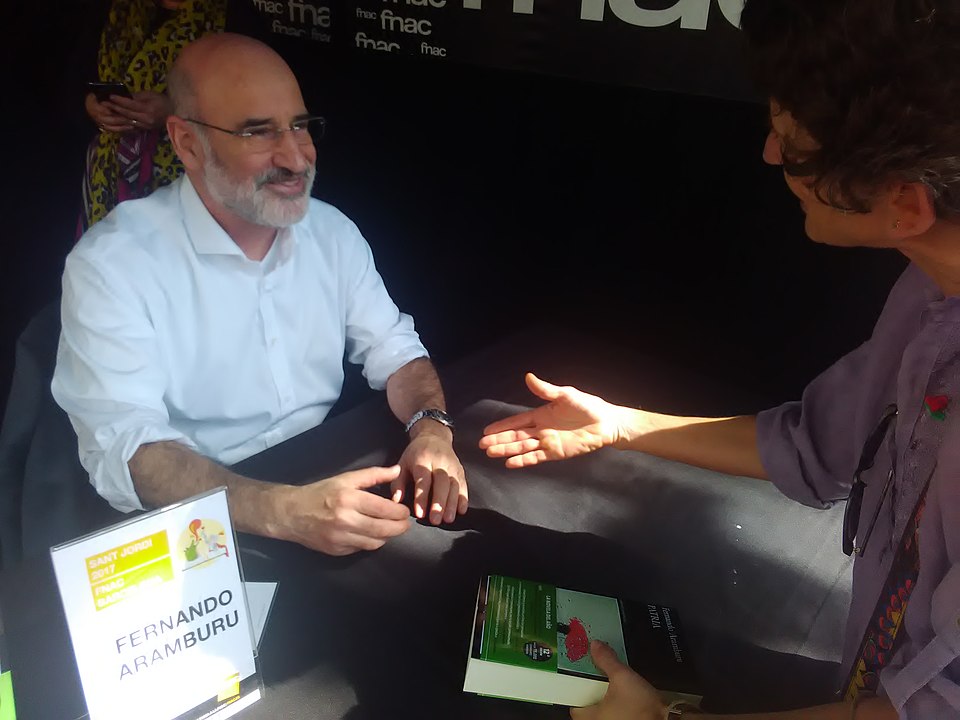
It’s a longer book than McEwan’s, some 700 pages, but it’s one of those tomes you never want to finish. It’s the life story of Toni, another man who is abandoned by his wife. She doesn’t leave him for her art, which is the case with Roland Baines, but for another woman. His marriage has been the latest in a series of failures. He believes that, although his life has been a disaster, this is not an accident that has happened specifically to him, either through circumstance or bad luck. He comes to the conclusion that life is a vale of tears and that failure is a constant, universal and inevitable part of the human condition. It is not worth living any longer. It only prolongs the misery. Existence is shit and he decides voluntarily to end it all. He seeks death for relief and not in expectation of resurrection. He is an atheist like Roland.
Nevertheless, he decides that he will continue with the ordeal that is his life for one more year, a period during which he will write in a notebook everything that happens to him every day. His diary leads him to remember episodes from his life that illuminate his past. He recalls them in a non-linear way, just like Roland Baines.
As we read the entries in his diary we realise how damaged Toni is as a result of the childhood abuse he suffered. He witnessed a lot of gender-based violence in his family of origin. Not only did his mother have to endure the macho brutality of her husband, but also Toni and his brother were victims of aggression that bordered on sexual abuse. His experiences at home marked him forever. He feels that his adult life has been a total failure. He does not seem to know how to form loving friendships, and sees the world as a rejecting place.
Although Toni is a philosophy teacher, he is not at all pretentious. Nor does he move in such intellectual circles or live in such progressive neighbourhoods as Roland. He leads a more sordid but no less intellectual life than Roland but, unlike him, he is not interested in summarising the history of Western civilisation, nor in making a compilation of the political events of contemporary Spain, although inevitably, national events have an impact on him and from time to time he comments upon them and entertains us with his observations.
Toni is sincere, like Roland, but more so. His confessions are brutal. He hides none of his vices. He writes with sarcasm and irony. He says things like a man who knows he only has twelve months to live, that he has an expiry date. He says things with no holds barred and with his own style of black humour.
McEwan tries to show that child abuse can be subtle but, in doing so, creates a weak example that misses the truth. On the other hand, Aramburu’s book is more concrete and more convincing and, above all, endearingly amusing.
 Ingleses