(A translation into English can be found below.)
Me tropecé con la palabra pecio por primera vez en un artículo publicado hace cinco años en El país. (https://elpais.com/cultura/2014/05/10/actualidad/1399735208_495369.html). Según el Diccionario del Real Academia Española un pecio es “un pedazo o fragmento de la nave que ha naufragado”. Así es lo que queda del Mary Rose, el buque insignia de Henry VIII de lo que escribí hace unos meses en “El astillero histórico de la marina británica” (2 Junio 2019).
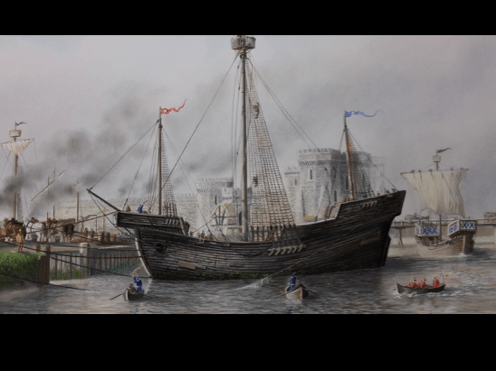
El mes pasado visité otro pecio en la ciudad de Newport en Gales; o sea, vi, por la ventana de una cámera de ambiente controlado, las maderas desmontadas del casco de un barco medieval vasco que se hundió en el siglo quince en el fango del río Usk. Se descubrió el casco parcial en 2002 mientras se sentaban las bases de un nuevo centro de artes en la ribera del río.
Aunque no quede un gran porcentaje de su estructura original, los arqueólogos dicen que se trata del más completo ejemplo de un barco mercantil europeo del siglo quince que se ha encontrado hasta ahora.
Una vez conservadas las maderas, los voluntarios del proyecto tienen programada la reconstrucción del casco y la exposición del barco entero en forma virtual, reconfigurando las cubiertas, los tres mástiles y las jarcias mediante un holograma superimpuesto sobre el pecio restaurado.
Entre los artefactos que se han recuperado de abordo hay balas de cañón de piedra de varios diámetros. En el siglo quince la piratería representaba un serio problema y todo buque mercante tenía que ser capaz de defenderse contra cualquier ataque. Entre otros hallazgos figuran varias herramientas de madera, unos zapatos poulaine (los típicos zapatos de punta medievales), además de los inevitables e imprescindibles peines para piojos.
Una investigación dendrológica ha demostrado que los árboles utilizados en la construcción del barco se talaron en un bosque de Guipúzcoa alrededor del año 1449. En tiempos medievales había mucho comercio entre los puertos del norte de España y la ciudad de Bristol. Sin embargo, las tasas portuarias bristolianas eran muy elevadas y muchas veces resultaba más económico descargar las mercancías en los puertos de la orilla galesa del canal de Bristol. Las importaciones más importantes incluían vino, hierro, colorantes, trigo y lana, las últimas dos siendo materias primas que se importaban y se exportaban en ambos sentidos para mitigar las escaceses inoportunas cuandoquiera y comoquiera ocurrieran en los dos países. En el caso de la lana el intercambio servía también para satisfacer las demandas fluctuantes de las variedades específicas de vellones requeridas por los hilanderos, tintoreros y tejedores especialistas tanto en España como en Inglaterra.
Queda mucho por hacer antes de que el barco pueda ser reconstruido y exhibido en una galería adecuada. Antes de que se llegue a tal punto, se puede visitar el centro los viernes y los sábados entre las 10.30 y 16.00 aunque tengo entendido que el horario puede variar durante el invierno. (Detalles en la web de Friends of the Newport Ship: https://www.newportship.org/)
Ya sé, ya sé. Este es “Ingleses” y Newport se sitúa en Gales. Vale, pero está justo al otro lado de la frontera a unos 30 quilómetros de mi casa y el tema y la ciudad me interesan.
Wikipedia tiene dos entradas sobre el barco de Newport, una en inglés y otra en euskera. Que no tenga nada en galés no me sorprende porque Newport está situada cerca de la frontera con Inglaterra. En este rincón inferior derecho del país no hay ni díos que hable galés. El uso del idioma celta es nulo. Por razones políticas lingüísticas está empleado en señales de tráfico bilingües pero solo sirve para confundir a la gringada.
Me parece que en el caso de Newport los nacionalistas galeses se han dado por vencido y han abandonado la ciudad a su suerte inglesa. Newport está dominada por las ciudades vecinas. Se encuentra entre Bristol y Cardiff, es decir entre una próspera ciudad inglesa y la importante e igualmente próspera capital galesa. Algunos cardiffianos bromean de sus pobres vecinos de Newport, llamándoles “ingleses” (hay que señalar que tampoco se oye mucho galés en Cardiff), y los ingleses tienden a mirarles por encima del hombro, con una mezcla de menosprecio y repugnancia.
Hasta los años 60 Newport era todavía una ciudad exportadora de carbón y disfrutaba de una pujante industria siderúrgica pero hace tiempo que las minas cerraron y el acero no es lo que era. Ahora, si te das un paseo por el centro commercial te das cuenta de que el sector minorista esta atravesando una mala racha. Es evidente que la gente no tiene el poder adquisitivo para sostener tiendas de primera categoria. A simple vista la ciudad te parece algo fea.
Pero la belleza está en los ojos de quien la mira. Aunque la ciudad se haya caído en tiempos difíciles y no tenga las tiendas y las típicas grandes atracciones turísticas de que gozan sus vecinas, lo que sí tiene Newport es su arqueología industrial y naval y este aspecto de su historia es de especial interés. Por ejemplo, tiene un puente colgante — uno de los dos que quedan en el país entero — igual que él de Bilbao que cruza el río Nervión y que une Portugalete con Getxo. Este fue construido en 1893 y el ingeniero encargado de la construcción fue el francés Ferdinand Joseph Arnodin, el mismo que más tarde diseñó el puente colgante de Newport que data de 1906.
También Newport tiene los canales por los que en siglos pasados el carbón y el mineral de hierro eran transportados desde las minas a las fundiciones y las dársenas de la ciudad. Hoy en día, más allá de la ciudad, en la campiña galesa, esos canales ya se han convertido en lugares de ocio y los narrow boats, los tradicionales barcos británicos que llevaban materias primas, se han hecho embarcaciones de recreo que se alquilan para cubrir el hermoso trayecto entre los pueblos de Pontypool, Abergavenny y Brecon.
Pero cuanto más se acercan los canales a la ciudad de Newport, más derelictos se vuelven. Hay trechos en vías de restauracion pero queda mucho por hacer hasta que las rutas sean navegables en su totalidad. Vale la pena visitar el Fourteen Locks Canal Centre, al norte de Newport, donde una serie de 14 exclusas bajaban el canal 50 metros en una distancia de solo 740 metros. Este trecho ha sido parcialmente reparado y se espera que un día los narrow boats puedan volver a llegar al centro de la ciudad.
La historia de Newport y el río Usk se remonta a una época más remota que la de los orígenes de Bristol o Cardiff. En las afueras de la ciudad, río arriba, es el antiguo puerto y fortaleza romano, Caerleon. Igual que la ciudad de León, Caerleon debe su nombre a la legión romana que se destacaba ahí. Caer o gaer quiere decir fortaleza en galés y leon es una contracción de legión. Es otro sitio que vale la pena visitar. El museo nacional de la legión romana se encuentra ahí, cerca de los restos del anfiteatro. Detalles online.
Espero que el proyecto del barco medieval ayude a la popularización de la historia de Newport y el río Usk y que llegue a ser una valiosa aportación a la industria turística de la ciudad.
The Newport Medieval Boat
I first came across the word pecio in an article published five years ago in El país. (https://elpais.com/cultura/2014/05/10/actualidad/1399735208_495369.html). According to the Dictionary of the Spanish Royal Academy a pecio is a “piece or fragment of the shipwrecked vessel”, as is what remains of the Mary Rose, the flagship of Henry VIII, about which I wrote a few months ago in “El astillero histórico de la marina británica” (2 June 2019).
Last month I visited another pecio in the city of Newport in South Wales; rather, I saw, through the window of an environmentally controlled chamber, the disassembled planks of the remains of the hull of a medieval Basque ship that sank in the fifteenth century in the mud of the River Usk. The remains of the hull were discovered during the sinking of the foundations for a new arts centre on the riverbank.
Although not a great deal remains of the original structure, archaeologists say that this is the most complete example of a 15th century European merchant boat that has been found up until now.
Once the planking has been preserved, the project volunteers have planned the reconstruction of the hull and the display of the entire boat in a virtual form, superimposing a hologram on the rebuilt pecio in order to reconfigure the decks, the three masts and the rigging.
Amongst the artefacts that have been rescued from aboard are a number of stone cannonballs of various diameters. In the 15th Century piracy represented a serious problem and every merchant vessel had to be capable of defending itself against attack. Amongst the other finds are several wooden tools, a few poulaines (the typical medieval pointed shoes), as well as the inevitable and indispensable nit combs.
A dendrological study has revealed that the trees used in the construction of the boat were felled in a wood in the province of Guipúzcoa around the year 1449. In medieval times there was considerable trade between Bristol and the ports along the north coast of Spain. However, the levies at the port of Bristol were very high and it was cheaper to unload goods at the ports on the Welsh side of the Bristol Channel. The most important imports included wine, iron, dyes, wheat and wool, the latter two being raw materials that were imported and exported in both directions whenever there was a need to compensate for untimely shortages whenever and wherever they might occur in either country. In the case of wool the interchange served also to satisfy the fluctuating demand for the specific varieties of fleece required by the specialist spinners, dyers and weavers both in England and Spain.
A lot remains to be done before the boat can be rebuilt and displayed in a suitable gallery. Before the project gets to this point you can still visit the centre on Fridays and Saturdays between 10.30 and 16.00 although I am given to understand that the opening hours may vary during the Winter. Details can be found on the web page of Friends of the Newport Ship: https://www.newportship.org
I know, I know. This is “Ingleses” and Newport is in Wales. Very well, but it is only just over the border, some 30 kilometres from my house, and the subject and the city both interest me.
Wikipedia has got two entries about the boat, one in English and one in Basque. That it contains nothing in Welsh doesn’t surprise me as Newport is situated near the English border. In this bottom right-hand corner of the country absolutely no one speaks Welsh. The use of the Celtic language is zero. For politico-linguistic reasons it is used on bilingual traffic signs but it only serves to confuse the gringos.
It seems to me that the Welsh Nationalists have given up on Newport and they have abandoned the city to its English fate. Newport is dominated by its neighbouring cities. It is located between Bristol and Cardiff, that is between a prosperous English city and the important and equally prosperous capital of Wales. Some Cardiffians joke about their poor neighbours in Newport, calling them English (it has to be said that you don’t hear much Welsh in Cardiff either) and the English tend to look down on them with a mixture of revulsion and scorn.
Until the 60s Newport was still a city that exported coal and enjoyed a thriving steel manufacturing industry, but the mines closed a while ago and steel isn’t what it was. If you take a walk around the shopping centre you realise that the retail sector is going through a bad patch. It’s obvious that people don’t have the buying power to sustain top rank shops. At first glance the city seems somewhat ugly.
But beauty lies in the eye of the beholder. Although the city may have fallen on difficult times and doesn’t have the shops and the typical tourist attractions of its neighbours, what Newport does have is its industrial and naval architecture and it is this aspect of its history that is of special interest. For example, it has a working transporter bridge — one of only two left in the entire country — very similar to the one in Bilbao which crosses the River Nervión and links Portugalete with Getxo. The latter was built in 1893 and the French engineer in charge of its construction was Ferdinand Joseph Amodin, the same man who later designed the transporter bridge in Newport which dates from 1906.
Newport also has the canals along which in past centuries the coal and iron ore was transported to the city’s foundries and docks. Nowadays, beyond the city, in the welsh countryside, these canals have already been transformed into leisure facilities and the traditional British narrow boats that used to carry the raw materials have become pleasure craft that people hire to travel along the beautiful sections between Pontypool, Abergavenny and Brecon.
But the closer that the canals get to Newport the more derelict they become. There are stretches in repair but there remains a lot to do before they are fully navigable. It’s worth a visit to the Fourteen Locks Canal Centre, in the north of Newport, where a series of 14 locks used to lower the canal 50 metres in a distance of 740 metres. This stretch ha been partially repaired and it is hoped that one day the narrow boats will be able to return to the centre of the city.
The history of Newport and the River Usk goes back to a more remote time than that of the origins of either Bristol or Cardiff. Upriver, in the outskirts of the city lies the former roman fortress and port of Caerleon. The same as the city of León, Caerleon owes its name to the roman legion that was stationed there. Caer or Gaer means fort in Welsh and leon is a contraction of legion. Another place worth a visit. The National Roman Legion Museum is there, along with the remains of the amphitheatre. Details on line.
I hope the Medieval Boat Project helps in the popularisation of the history of Newport and the River Usk and that it becomes a valuable contribution to the tourist industry of the city.
 Ingleses