Steven Spielberg. What is the Function of a Musical?

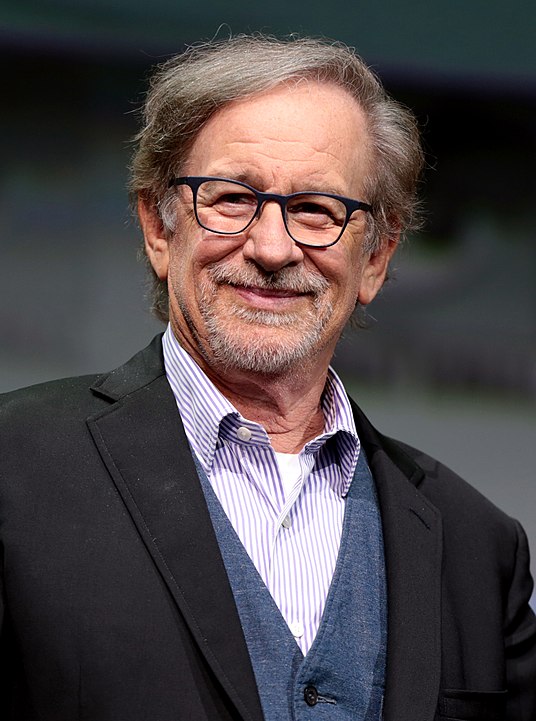
Steven Spielberg. Photo by Gage Skidmore via Wikimedia Commons

My God, I have read some pretentious opinions about the new West Side Story, none of which have been more pompous than those of the director himself.

Steven Spielberg tells us that he fell in love with West Side Story at the tender age of 9. Fine, I can’t blame him for that. I, too, by the age of 13, had already seen the film a dozen times. Every week of the summer holidays I would take the bus to the centre of town to hand over my weekly pocket money at the box office of the Curzon cinema. I never tired of the music of Leonard Bernstein and the balletic choreography of Jerome Robbins. The music and the dance thrilled me like nothing else. That’s why I can understand 100% how you can be in love with a film.

Up till that summer I had frequented the Embassy, a flea pit (but cheap) where they used to show old films like Gold Diggers of 1933 (1933) with Ginger Rogers and Dick Powell, Road to Morocco (1942) with Bing Crosby, Bob Hope and Dorothy Lamour, and Calamity Jane (1953) starring Doris Day. Until one day I got so fed up with all that old-fashioned nonsense, that I walked 200 yards down the road to see what was on at the Curzon.

West Side Story was something else.
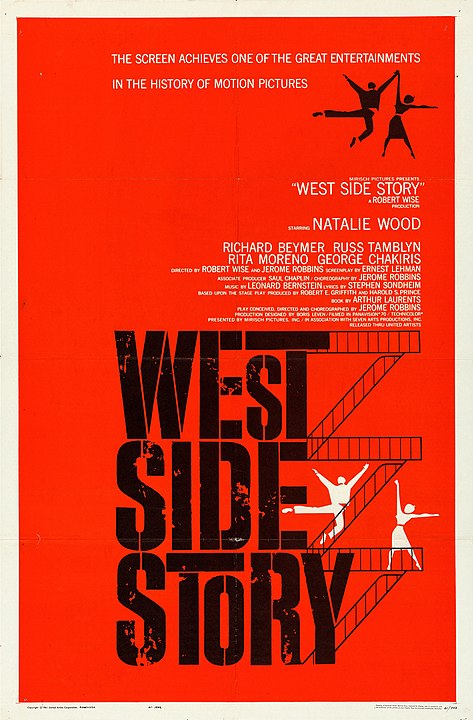
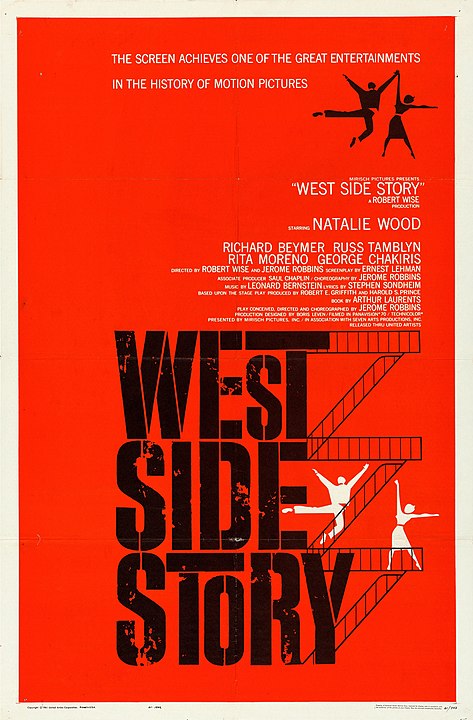
Poster for the 1961 version

Steven Spielberg claims that the object of his new version was to make the story and its characters more true to the 50s in New York, their lives more detailed and believable and their personalities deeper and more rounded. He wanted to make a version that was more acceptable and “less insulting” to a Puerto Rican audience. He added 5% of dialogue exclusively in Puerto Rican Spanish and did not provide subtitles. Just like Abdulrazak Gurnah with the Swahili vocabulary of his novels, Steven Spielberg didn’t want the Spanish translated; he believed that if the whole script had been exclusively in English, this would have impoverished the authentic atmosphere he was trying to create. He sought out young actors of Puerto Rican descent and schooled them in their grandparents’ idioms. He even, in order to protect the sentiments of the Puerto Rican people, censored the lyrics of the famous song “America”, eliminating the couplet in which Anita wishes that the island of her birth should «sink back in the ocean». His West Side Story would be politically correct, a more appropriate parable for our times, a musical against racism and xenophobia.

This is how Steven Spielberg expressed himself, in lofty terms with which no one can disagree and from which no one would wish to dissociate themselves. There is no one today who would dare say no to this goal, because it is all very commendable from a modern perspective that wants to be scrupulously fair to all.

BUT I suspect that Steven Spielberg’s underlying motive has little to do with what he says. What confirms me in this opinion is that he announced before filming that this new West Side Story would be his last film. In other words, to celebrate his retirement, he was going to dedicate his final work to one of his first loves. More than anything else, his swan song is an act of homage and veneration and, at the same time, a sentimental return to his childhood.

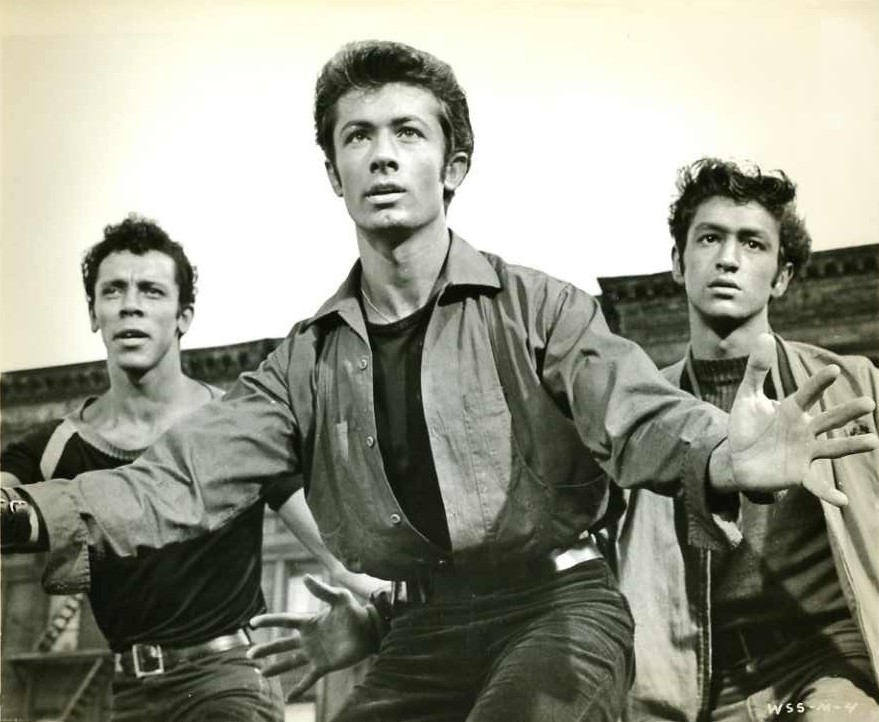
His politically correct motives, his recourse to all the modern clichés about equality, don’t ring true. Since when has it been necessary for a musical to be a faithful representation of reality? Nobody goes to the cinema to see a musical in an attempt to understand delinquency on the streets. It matters little to anybody that the new actor who plays the wife of the leader of the Sharks should be darker skinned than the Anita of the first version. Or that her partner from the first version, George Chakiris, was Greek. And the extra words in Spanish don’t add much.

George Chakiris in the 1961 version

I may be wrong but it doesn’t seem to me that the new West Side Story has generated any great interest amongst Puerto Ricans. The changes carried out by the new director are irrelevancies to them. If they do feel offended and looked down on, this will have more to do with the unfortunate present reality of the island, caused by the negligent way in which the USA has treated its colony of Puerto Rico throughout the last few years. In 2015 this US territory was obliged to declare itself bankrupt because of the island’s poor administration. In 2017, in the space of one month, the island was battered by 2 hurricanes which caused thousands of deaths and devastated an already weak economy. After the hurricanes came the earthquakes, more than 2000 tremors which claimed more lives, collapsed more buildings and further disrupted the infrastructure.

Despite the fact that the island belongs to one of the World’s most prosperous economies it has yet to recover from the damage inflicted by its recent natural disasters, its poor administration and bankruptcy. It has a National Grid which still has not completely recovered. More than ever, the local people are abandoning their own country to seek their fortune in the States. Today, there are more Puerto Ricans in the USA than on their own island and the words of “America” are more relevant than ever.

Is the American musical an appropriate vehicle for dealing with important matters? I don’t think so. The musical is a frivolous genre, an extravaganza of love, dreams and dance, a journey to wonderland. It is light-hearted fun, a fairy tale, a brightly coloured spectacle full of young, good- looking actors.  If this wasn’t the case we would already have had South Atlantic, a clone of South Pacific, only this time set during the Falklands War. Perhaps also, a North Atlantic which tackled the triangular slave trade, a film in which the African slaves dance in leg irons aboard the slave ships. Or Indian Ocean, a musical about the disappearance of the Maldives beneath the waves as a result of the rise in the level of the sea occasioned by global warming.  We could have amused ourselves watching the natives dancing on their roofs with the seawater up to their ankles. It would also have been high time for a song and dance western about the genocide of the Native American people.

With this, I return to the starting point. Fundamentally, Steven Spielberg is caught up in the romanticism of a film which he fell in love with 65 years ago. His motivation comes from wanting to be amongst his best friends, having fun with a makeover of one of the loves of his life. And he adores mixing with the survivors of the cast of 1961.

If he had really set out to make entertainment that adds something to the debate about the inherent racism in American society, he might have tried to direct something more like Passing or Queenie and Slim, modern films that not only contain a strong anti-racist message but also a musical soundtrack.

“Steven, you can’t justify your desire to relive your childhood by reciting all the modern clichés about equality. It’s obvious that your yearning to do something politically correct was just a pretext to tinker with a film that many people thought was already perfectly placed in its own time and didn’t need anyone to update it.”

Does it add anything to the original?

Yes. 3 minutes. But the last half an hour seems to go on forever. 

PS The idea of modifying the dialogue to allow the actors to express themselves a little more in their own language makes me think of what could be done with William Shakespeare’s original Romeo and Juliet which was first performed in 1597. Perhaps in the future there will be a remake of the stage play in which some director follows Steven Spielberg’s example and for the first time in over 425 years incorporates 5 percent of authentic 16th century Italian dialogue into the script, thus adding a new note of realism to the production.
Steven Spielberg, ¿Cuál es el propósito de un musical?

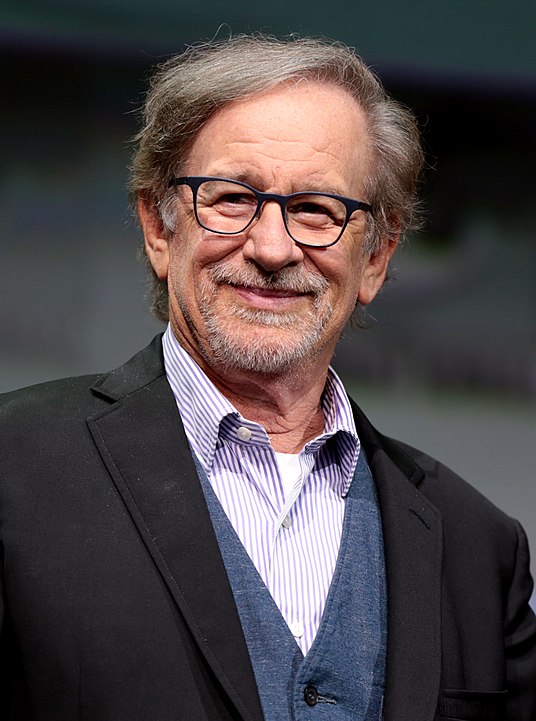
Steven Spielberg foto: Gage Skidmore via Wikimedia Commons

Dios mío, he leído unas opiniones pretenciosas sobre el nuevo West Side Story, ninguna de ellas más presumidas que las del propio director.

Spielberg dice que se enamoró del West Side Story a la corta edad de 9 años. Bueno, no le puedo culpar por eso. Yo también, para la edad de 13 años, ya había visto la película doce veces. Cada semana de las vacaciones veraniegas yo tomaba el bus al centro de la ciudad para entregar mi paga semanal a la taquillera del cine Curzon. Nunca me cansé de la música de Leonard Bernstein y la coreografía del ballet de Jerome Robbins. La música y el baile me emocionaban. Por eso es por lo que puedo entender cien por cien como se puede enamorarse de una peli.

Hasta aquel verano yo solo había frecuentado el Embassy, un cine de mala muerte (pero de bajo coste) donde ponían películas antiguas como Gold Diggers of 1933 (1933) con Ginger Rogers y Dick Powell, Road to Morocco (1942) con Bing Crosby, Bob Hope y Dorothy Lamour, y Calamity Jane (1953) con Doris Day. Hasta que, un día, harto de tanta cinebasura trasnochada, me trasladé unos 200 metros calle abajo al Curzon a ver lo que se ofrecía allí. 

West Side Story era otra cosa.  

Cartel de la version de 1961

Steven Spielberg afirma que el objetivo de su remake, era él de hacer que la historia y los protagonistas fueran más fieles a la época de los 50 en Nueva York, sus vidas más detalladas y creíbles y sus personalidades más profundas y redondeadas. Quería hacer lo que él consideraba una versión más aceptable y “menos insultante” al público puertorriqueño.  Añadió un 5 por ciento de diálogo exclusivamente en el español boricua de los 50 y no le dio subtítulos. Igual que hace Abdulrazak Gurnah con el vocabulario suajili de sus novelas, Steven Spielberg no quería que el español se tradujera; creía que si todo el guión hubiera sido exclusivamente en inglés esto habría empobrecido el ambiente auténtico que él intentaba crear. Buscaba actores jóvenes de ascendencia puertorriqueña y les educó en los modismos de sus abuelos. Incluso, para proteger a los sentimientos de la gente boricua, censuró la lírica de la famosa canción, “America”, suprimiendo la copla en la que Anita desea que la isla de su nacimiento se vuelva a hundir en el océano. Su West Side Story sería una peli «correcta», una parábola más apropiada para los tiempos que corren, un musical contra el racismo y la xenofobia. 

Así se expresaba Steven Spielberg, en términos elevados con los que no hay nadie que pueda discrepar y de los que nadie quisiera desmarcarse. No habrá nadie hoy en día que se atreva decir que no a este objetivo porque todo esto es muy loable desde la perspectiva moderna que quiere ser escrupulosamente justa con todos.

PERO sospecho que el motivo fundamental de Steven Spielberg tiene poco que ver con lo que dice. Lo que me confirma en esta opinión es que el anunciara antes del rodaje que esta nueva West Side Story sería su última película. Es decir, para celebrar su jubilación iba a dedicar su obra final a uno de sus primeros amores. Más que nada, su canto de cisne es un acto de homenaje y veneración y, a la vez, un retorno sentimental a su niñez.

Sus motivos políticamente correctos, eso de recurrir a todos los tópicos modernos sobre la igualdad, no parecen convincentes. ¿Desde cuándo ha sido necesario que un musical sea una representación fiel de la realidad? Nadie va al cine a ver un musical en un intento de entender las causas de la delincuencia callejera. A nadie le importa demasiado que la nueva actriz que interpreta el papel de la mujer del líder de los Shark sea más prieta que la Anita de la primera peli. Ni que su pareja de la primera peli, George Chakiris, fuera griego. Y no añade mucho que haya unas cuantas palabras extras en español.

George Chakiris en la versión de 1961

Puede que me equivoque pero no me parece que la nueva West Side Story haya generado gran interés entre los puertorriqueños. Los cambios llevados a cabo por el nuevo director son unas irrelevancias para ellos. Si se sienten ofendidos y ninguneados eso tendrá más que ver con la desafortunada realidad actual de la isla, a causa de la manera negligente en que EEUU ha tratado a su colonia de Puerto Rico a lo largo de los últimos años. En 2015 este territorio estadounidense se vio obligado a declararse en proceso de quiebra por la mala administración de la isla. En 2017, en el espacio de un mes, la isla fue azotada por dos huracanes que causaron miles de muertos y devastaron una economía ya bastante débil. Después de los huracanes vinieron los terremotos, más de 2000 movimientos sísmicos que se cobraron más vidas, derrumbaron más edificios y perturbaron aún más las infraestructuras.

A pesar de que la isla pertenece a una de las economías más prósperas del mundo no se ha recuperado todavía de los daños infligidos por los desastres naturales recientes, la mala administración y el estado de quiebra. Tiene una red eléctrica que aún no se ha restablecido del todo. Más que nunca la gente indígena está abandonando su país para buscarse la vida en EEUU. Hoy en día hay más puertorriqueños en EEUU que en la propia isla y “America” es una canción más relevante que nunca.

¿Es el musical norteamericano el vehículo adecuado para indagar en temas trascendentes? Creo que no. El musical es un género frívolo, una extravaganza de amores, sueños y bailes, un viaje al país de las maravillas. Es una diversión ligera, una cuenta de hadas, un espectáculo de colores vivos lleno de actores jóvenes y bien plantados.  La razón por la que nos enamoramos de los musicales es que son una dosis de algo entretenido, muchas veces azucarado y edulcorado, una píldora dorada, un antidepresivo. La clave está en el nombre: musical.  No hay tal cosa como un musical realista.

Si esto no fuese el caso ya habríamos tenido South Atlantic, un clon de South Pacific, esta vez ambientado en la guerra de las Malvinas. Quizás, también, una North Atlantic que encara la historia de la trata transatlántica de esclavos, una película en la que los esclavos africanos bailan en grilletes a bordo de los barcos negreros. O Indian Ocean, un musical sobre la desaparición de los Maldives debajo de las olas a consecuencia del aumento del nivel del mar ocasionado por el calentamiento global. Nos podíamos haber divertido viendo a los indígenas bailando sobre sus tejados hasta los tobillos de agua de mar. Y ya habría sido hora de un western de canto y danza sobre el genocidio de la gente nativa norteamericana.

Con este reductio ad absurdum, vuelvo al punto de partida. Fundamentalmente, Spielberg está absorto en el romanticismo de una peli de la que se enamoró hace 65 años. Su motivación viene de querer estar entre sus mejores amigos, divirtiéndose con una remodelación de una de las pasiones de su vida. Y le encanta mezclarse con los supervivientes del reparto de 1961. 

Si realmente se hubiera planteado hacer un entretenimiento que añade algo al debate sobre el racismo inherente en la sociedad norteamericana, podría haber intentado rodar algo más parecido a Passing o Queenie and Slim, unas películas modernas que no solo contienen un fuerte mensaje antirracista sino también una banda sonora musical.

“Steven, no tienes que justificar tu deseo de revivir tu niñez recitando todos los tópicos modernos sobre la igualdad. Es evidente que tu anhelo de hacer algo políticamente correcto solo era el pretexto de juguetear con una película que mucha gente cree que ya estaba perfectamente situada en su propia época y no necesitaba que alguien la actualizara.” 

¿Añade algo al original? 

Sí. 3 minutos. Pero la última media hora se hace muy, muy larga.

PD La idea de modificar el diálogo para que los actores se expresen un poco más en su propio idioma me hace pensar en lo que se pudiera hacer con el Romeo y Julieta original de William Shakespeare que se estrenó en 1597. A lo mejor en el futuro habrá una versión nueva del drama original en la que algún director siga el ejemplo de Spielberg y por primera vez en más de 425 años se incorpore al guión un 5 por ciento del italiano auténtico del siglo 16, añadiendo así una nueva nota de realismo a la drama.

.