
Is the Influence of the Gulf Stream on the Climate of North-West Europe Overestimated?

Photo by Daderot. It is taken for granted that Cornish gardens such as Heligan can only exist thanks to the Gulf Stream

Gardeners in Great Britain and Ireland maintain that the temperate climate of the British Isles allows them to grow plants from all over the globe. They talk of the benefits of the tropical waters that flow northeast from the Gulf of Mexico and wrap their blessed winter warmth around the fortunate shores of the British Isles, mitigating the effects of the cold that every Winter plunges down from the North Pole.

At this point you have to disregard some parroquial exaggeration. Some coastal areas in the British Isles are often shamelessly described by the domestic travel industry and by tv gardening programmes in Great Britain as “subtropical”. This term tends to cause some derision amongst non-gardeners as well as visitors from abroad. The juxtaposition of the words “subtropical» and “British Isles” tend to conjure up ludicrous images of coconut palms on Brighton beach ( I don’t mean Brooklyn, although that is just as unlikely!) In reality, all the term subtropical signifies here, is that there is less frost in Winter.

However, even this small climatic benefit could disappear. The magazine Nature Geoscience has recently published an article which shows how the Gulf Stream has been weakening for the past two millennia and how this decline has become ever more serious throughout the 20th century: https://doi.org/10.1038/s41561-021-00699-z. In the future, the Gulf Stream might not arrive at the shores of the British Isles as strongly as before. 

Indeed, it may no longer arrive at all. The New York Times points out that another potential setback to the Gulf Stream is the new obstacle in its path: a cold blob of water in the North Atlantic that has arisen just south of Greenland due to the large flow of meltwater flowing south from the North Pole. There is a possibility that this could divert the course of the Gulf Stream away from North-West Europe. (New York Times: In the Atlantic Ocean, Subtle Shifts Hint at Dramatic Dangers. 13/03/2021)

But, all may not be lost.  According to Richard Seagar in the American Scientist magazine in 2006 ( The Source of Europe’s Mild Climate ), the idea that it is the Gulf Stream which is mainly responsible for North-West Europe’s mild winters is an outdated and blindly accepted axiom which was made popular by Matthew Fontaine Maury, an American naval officer who in 1855 published The Physical Geography of the Sea, often considered the first textbook of physical oceanography. Maury wasn’t the first to chart the Gulf Stream. Benjamin Franklin did so in 1769, not as an aide to understanding the climatology of Europe but in order to help speed transatlantic mailboats. An article in the New York Times of February 6, 1980, documents the rediscovery of prints of Franklin’s original chart. (“Prints of Franklin’s Gulf Stream Chart found.”)
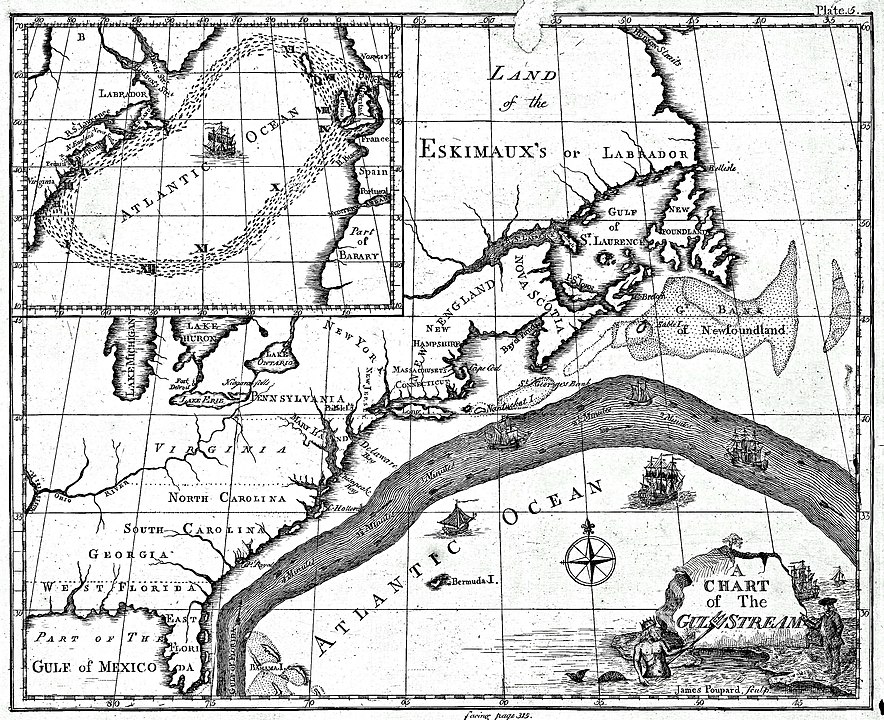
The first known chart of the Gulf Stream (1769), Library of Congress/Benjamin Franklin

To challenge the hegemony of Maury’s theory, Seagar pulls together the ideas of several prominent atmosphere modellers, practitioners of a modern discipline which didn’t exist prior to the 1960s, over a hundred years after Maury wrote his pioneering book. Coincidentally, it was exactly the time I was at secondary school and I well remember my old geography master, Mr Plail, alliterating the paramount importance to Britain’s farmers of the “warm, wet, westerly winds in Winter”.

According to these experts (not forgetting Mr Plail), the truth is that this warmth has more to do with the air flow in the northern hemisphere which moves from west to east, spinning south over the Rockies and subsequently veering north-west over the Atlantic, sweeping warm air away from the south-eastern states of the US and delivering it to NW Europe. 

In addition, Seagar argues that the major contribution of the sea to Britain’s mild weather is not the effect of the Gulf Stream but the simple absorption by the waters around the islands of the heat of the sun throughout the summer and their gradual release of warmth during the winter. The prevailing south-west wind, the importance of which he has already noted, helps to disperse this warmth over the land. 

Seagar says that claims in the press that any change in the course of the Gulf Stream might plunge North-West Europe into a new Ice Age in which its winters come to resemble those of Newfoundland, are alarmist and sensationalist. 

The blame, he says, lies with modern-day climate scientists who either continue to promulgate the Gulf Stream climate myth or who decline to clarify the relative roles of atmosphere and ocean in determining European climate. They always fail to mention that the poleward transport of heat by the atmosphere exceeds that by the ocean several-fold.

¿Se sobreestima el papel que la Corriente del Golfo desempeña en el clima del noroeste de Europa?

Foto por Daderot. Se da por sentado que los famosos jardines de Cornualles como Heligan solo son posibles gracias al calor de la Corriente del Golfo.

Los jardineros de Gran Bretaña e Irlanda sostienen que el clima templado de las Islas Británicas les permite cultivar plantas de todo el mundo. Hablan de los beneficios de las aguas tropicales que fluyen desde el Golfo de México hacia el noreste del Atlántico, envolviendo sus islas bienaventuradas en un baño de agua tibia que sirve para mitigar los efectos del frío que desciende cada invierno del polo norte.

Tienes que ignorar una cierta exageración local. La industria turística doméstica y los programas televisivos de jardinería de Gran Bretaña se refieren habitualmente y sin vergüenza a las “áreas costeras subtropicales” de las islas británicas. Esta terminología produce cierta burla entre los no jardineros y los visitantes del extranjero. La yuxtaposición de las palabras “subtropicales” e “islas británicas” tiende a evocar imágenes ridículas de palmeras de coco en la playa de Brighton. Hay que tener en cuenta que aquí, el término subtropical solo significa “menos heladas en invierno”.

Pero, según algunos climatólogos, hasta esa pequeña bendición podría desaparecer. La revista Nature Geoscience acaba de publicar un estudio que demuestra que la Corriente del Golfo lleva dos milenios debilitándose y la ralentización se ha hecho aún más marcada a lo largo del siglo veinte:  https://doi.org/10.1038/s41561-021-00699-z. Puede que, en el futuro, la Corriente del Golfo no siga llegando tan fuerte como antes.

Quizás, no llegue en absoluto. El New York Times señala que un nuevo obstáculo que la Corriente tiene que superar es la masa de agua fría que se ha ido acumulando en el Atlántico del norte al suroeste de Groenlandia debida a la cantidad de agua de deshielo que lleva décadas fluyendo del Polo norte. Esta masa de agua fría pudiera desviar la Corriente fuera del noroeste del continente europeo. (New York Times: In the Atlantic Ocean, Subtle Shifts Hint at Dramatic Dangers. 13/03/2021)

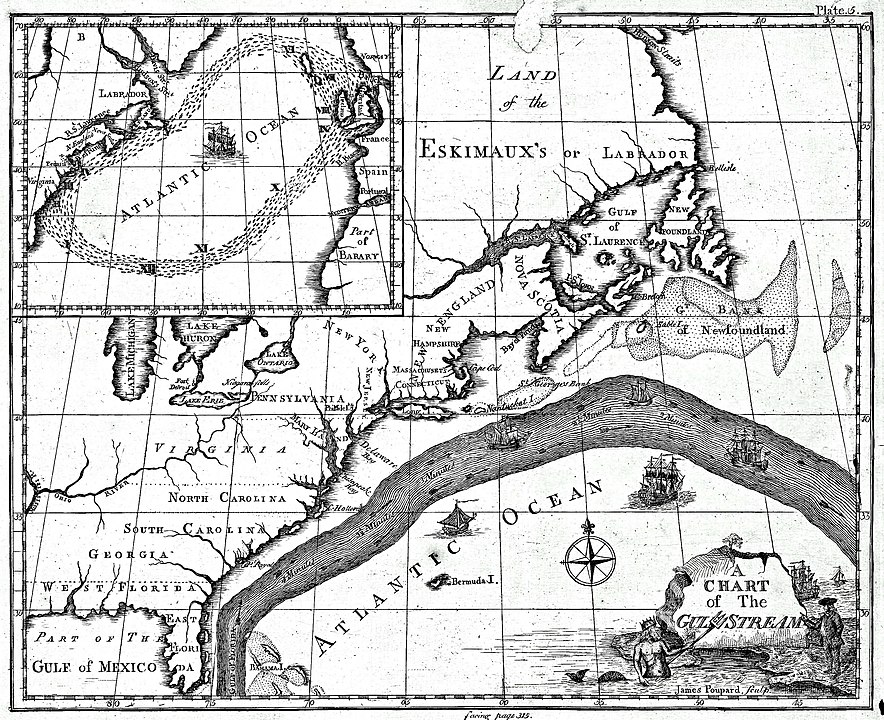
Pero, tal vez no todo esté perdido. Según Richard Seagar en un artículo publicado en la revista American Scientist del año 2006 ( The Source of Europe’s Mild Climate ), la idea de que la Corriente del Golfo tenga la mayor responsabilidad de los inviernos templados del noroeste europeo es un axioma trasnochado y aceptado a ciegas. Fue popularizado por Matthew Fontaine Maury, un oficial de la marina norteamericana que, en 1855, en La Geografía Física del Océano, un volumen considerado por muchos el primer libro de texto de la oceanografía física. Maury no era la primera persona para trazar el trayecto de la Corriente del Golfo. Benjamin Franklin lo hizo en 1769, aunque no lo hizo para elucidar la climatología de Europa, sino para reducir el tiempo de travesía de los barcos de correo transatlánticos. Un artículo en el New York Times del 6 de febrero de 1980 documenta el redescubrimiento de copias de la carta original de Franklin. (“Prints of Franklin’s Gulf Stream Chart Found.”)

La primera carta conocida de la Corriente del Golfo (1769). Library of Congress/Benjamin Franklin

Para cuestionar la hegemonía de la teoría de Maury, Seagar aglutina las ideas de varios expertos en la modelación de la atmósfera, practicantes de una disciplina moderna que no existía antes de los años 60, más de 100 años después de que Maury escribiera su libro pionero. Por coincidencia, los 60 fueron la década de mis años en el insti, y recuerdo bien las palabras de mi viejo profe de geografía, Mr Plail, que siempre hacía hincapié en el papel de suma importancia que desempeñan el viento y la lluvia en el trabajo de los agricultores de las Islas Británicas.  Somos, decía, los habitantes de unas islas afortunadas que gozan de vientos templados y lluviosos de componente oeste que mantienen a raya el frío del polo norte durante los meses del invierno.

Según estos expertos (sin olvidar al señor Plail), la verdad es que el origen de este calor tiene que ver principalmente con la circulación del aire en el hemisferio norte donde el aire se mueve del oeste al este. Al sobrevolar los Rockies el viento gira al sureste para virar después hacia el norte sobre el Atlántico, llevando por delante el aire caliente de los estados sudorientales de los EEUU y entregándolo a los países del noroeste de Europa.

Por añadidura, Seagar mantiene que la mayor contribución que el océano hace a la creación del suave clima británico no es el efecto de la Corriente del Golfo sino la simple absorción por las aguas alrededor de las islas del calor del sol a lo largo del verano y su subsiguiente liberación gradual durante el invierno. El viento suroeste predominante que sopla desde el mar hacia la tierra, la importancia del cual ya ha notado Seagar, ayuda a la difusión del calor.

Seagar dice que las afirmaciones en la prensa que cualquier cambio en el trayecto de la Corriente del Golfo pueda precipitar una nueva edad de hielo en el noroeste de Europa en la que los inviernos vengan a parecerse a los de la provincia canadiense de Terranova, son sensacionalistas y alarmistas.

La culpa de este malentendido la tienen los climatólogos que siguen promulgando el mito de la importancia arrolladora de la Corriente del Golfo o aquellos que se nieguen a clarificar los papeles relativos que desempeñan el océano y la atmósfera en la determinación del clima europeo. Siempre omiten mencionar que el papel que desempeña la atmósfera en el transporte de calor en dirección al polo norte es varias veces más importante que él del océano.